 English
 русский
 عربى
عربى


add: North of Gaoxin North Road, east of Jinyun Road, Wannian High-tech Zone, Shangrao City, Jiangxi Province
Walk into any well-run flower shop and you will see the same sight: rolls of kraft paper stacked beside reels of transparent film, soft cotton tissue next to glossy pearlescent wraps, and a shelf of products labeled “waterproof” or “anti-fog.” For a shop owner or a freelance florist, the range is overwhelming. Which one should you actually buy next month?
Here is the short answer: no single paper is best for every flower arrangement. The right choice depends on four variables—the flowers themselves, the delivery and display conditions, the visual style your customers expect, and your unit-cost target. Once you evaluate those four variables, choosing wrapping paper becomes a repeatable decision rather than a guess. This guide explains each material’s strengths and limits, then shows you how to match materials to specific business scenarios.
Why There Is No Single Best Flower Wrapping Paper
The phrase “best paper” only makes sense inside a use case. A bouquet sold at a weekly farmers market needs something sturdy and cheap; a wedding bouquet delivered to a venue needs structure, elegance, and protection from condensation; a subscription-box bouquet shipped across town needs waterproofing above all. These are different products, and they need different wrapping materials.
Florists who try to standardize on one paper usually end up compromising on either appearance or protection. The more effective approach is to build a small portfolio of two or three materials and rotate them by occasion and season. This keeps inventory manageable while still giving customers variety.
Here are the main decision factors that separate a good material choice from a poor one:
- Transport distance and temperature exposure: a bouquet that sits in a delivery van or refrigerated cabinet needs materials that resist moisture, not just materials that look nice.
- Flower type and stem structure: heavy-headed blooms such as peonies or hydrangeas require the support of a stiffer paper, while delicate wildflowers can be crushed by one.
- Customer expectations of the finished look: rustic, romantic, minimal, or celebratory—each style is best served by a different family of materials.
- Budget per finished bouquet: materials range from a few cents per sheet to several times that, and the difference adds up quickly at high volume.
These factors interact. A waterproof plastic film may be the correct answer for a cash-and-carry flower stall in summer, but the same material will feel wrong for a bridal bouquet. The table below maps common business scenarios to the material families that tend to perform best in each.
| Business scenario | Primary material recommendation | Why it works |
|---|---|---|
| Retail flower shop, everyday bouquets | Kraft paper or cotton tissue with a transparent outer film | Balances natural aesthetics, structural support, and visible freshness. |
| Weddings and premium event work | Pearlescent film or matte film with gold-edge finishes | Adds a deliberate, elevated look that matches formal styling. |
| Same-day local delivery | Waterproof film, optionally combined with an inner tissue | Protects against rain, condensation, and handling stress. |
| Wholesale and market supply | OPP plastic film or simple kraft rolls | Keeps cost low while providing durability for high-volume handling. |
| Floristry workshops and DIY sessions | Cotton paper and lightweight kraft | Easy to cut, fold, and manipulate without specialist technique. |
Kraft Paper: The Everyday Workhorse
Kraft paper is the first material most florists reach for when they need a reliable, sturdy wrapper. It is strong, reasonably priced, and available in a wide range of colors and printed patterns. It also offers excellent structural support for bouquets with heavy heads because the paper holds its shape instead of collapsing against the stems.
Standard brown kraft has a natural, rustic character. That makes it a strong fit for farmers-market bouquets, dried-flower bundles, and any arrangement where the customer wants to feel a connection to the earthiness of the flowers themselves. Printed kraft in newspaper style or with English typography continues to be popular for cafe-style and vintage brand aesthetics.
For a supplier’s perspective, kraft’s main limitation is moisture. Uncoated kraft has no water resistance, and even minimal condensation will soften the paper and create visible stains. If you use kraft in a refrigerated display or on a rainy delivery day, look for a coated or laminated version rather than plain craft paper. These maintain the matte paper look while adding a barrier against water.
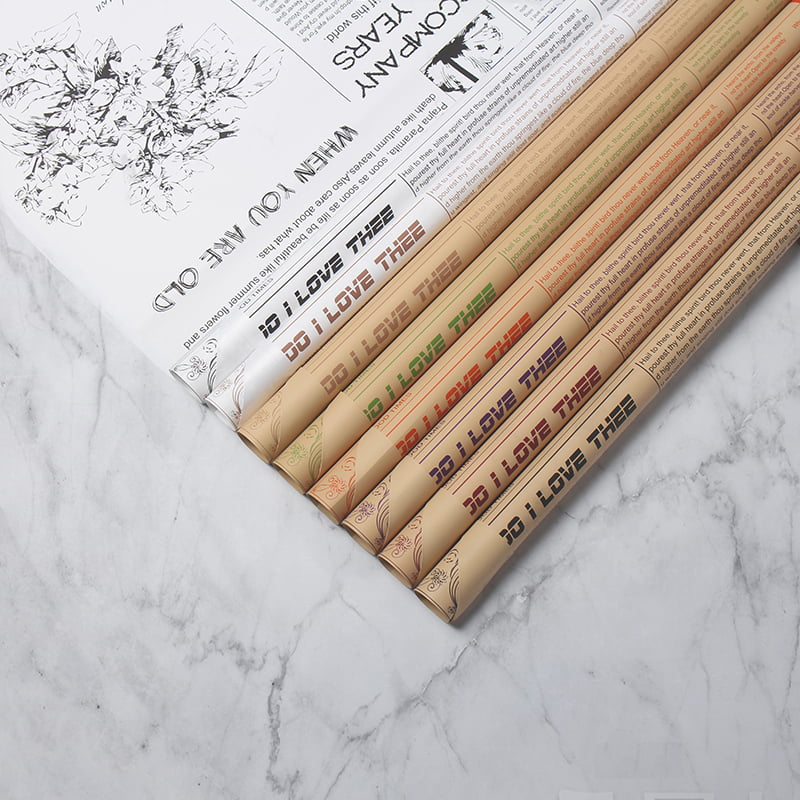 Retro Newspaper Style Cowhide Flower Wrapping PaperThis kraft paper features a retro newspaper print that adds historical charm to bouquets. Its coated surface resists moisture, making it suitable for displays or deliveries where condensation may occur.View Product →
Another practical point is thickness. Kraft roll goods typically range from around 35–50 gsm for lightweight wrapping up to 70–90 gsm for heavier presentation work. Thicker paper creases less, holds folds better, and does not tear at the staple point, but it also adds bulk to storage and increases the cost per bouquet. Decide on your typical bouquet weight before choosing a standard thickness.
Cotton Paper and Tissue: Softness and Inner Structure
Cotton paper and tissue occupy a different role from kraft. Instead of serving as the main outer shell, these materials are usually the first layer against the flower stems, or the decorative layer that softens the transition from stems to outer wrap. They are thin, flexible, and easy to crush into soft, cloud-like shapes.
Cotton fiber paper has a subtle texture that photographs well, which is why it shows up constantly in bouquet content on social media. Solid colors, polka dots, and small-scale prints are the most common designs in this category. It also performs well as an inner layer because it allows air circulation around the stems without adding heavy bulk.
There is one caution when buying pure cotton or tissue paper: it is not waterproof, and it offers almost no structural support on its own. A bouquet wrapped only in tissue will look delicate but will not survive long-distance delivery or wet conditions. The better pattern is to pair cotton tissue inside with a stronger outer material such as kraft, matte film, or transparent film.
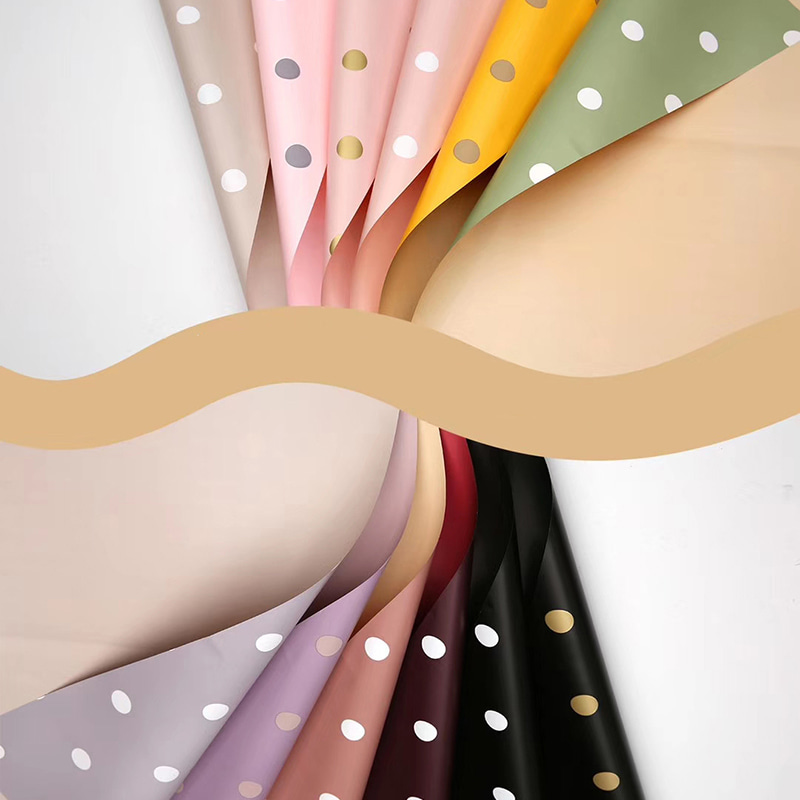 Single-Sided Polka Dot Cotton Flower Wrapping PaperCotton tissue with playful polka dots offers a soft, forgiving wrap that hides imperfect stems. Ideal as an inner layer beneath sturdier outer materials, it speeds up bouquet assembly for busy florists.View Product →
Cotton paper is also a good choice for florists who need fast wrapping workflows. It is forgiving to fold, does not require precise alignment, and crushes into soft shapes that hide imperfect stem arrangement. For volume operations, this translates directly into fewer minutes per bouquet.
Pearlescent Film: The Celebration Material
Pearlescent film is the material florists select when the bouquet itself may look simple but the wrapping needs to carry the occasion. The shimmering, light-reflecting surface instantly signals celebration, which is why it appears so consistently around wedding bouquets, Valentine’s Day arrangements, Mother’s Day gifts, and anniversary work.
Most pearlescent film on the market is made from BOPP film with a pearlescent coating or lamination. Because BOPP is a plastic-based substrate, the film is fully waterproof, so these wraps double as protective outer layers. That is an important functional advantage: you get the elevated look and the protection in the same sheet.
In practice, the strongest designs combine a pearlescent outer layer with a contrast inner layer, frequently a solid cotton paper or a printed tissue. The two layers provide depth, and the outer film gives clean crisp folds that hold their shape. Gold-edge pearlescent film adds another level of formality and is a common request for wedding work.
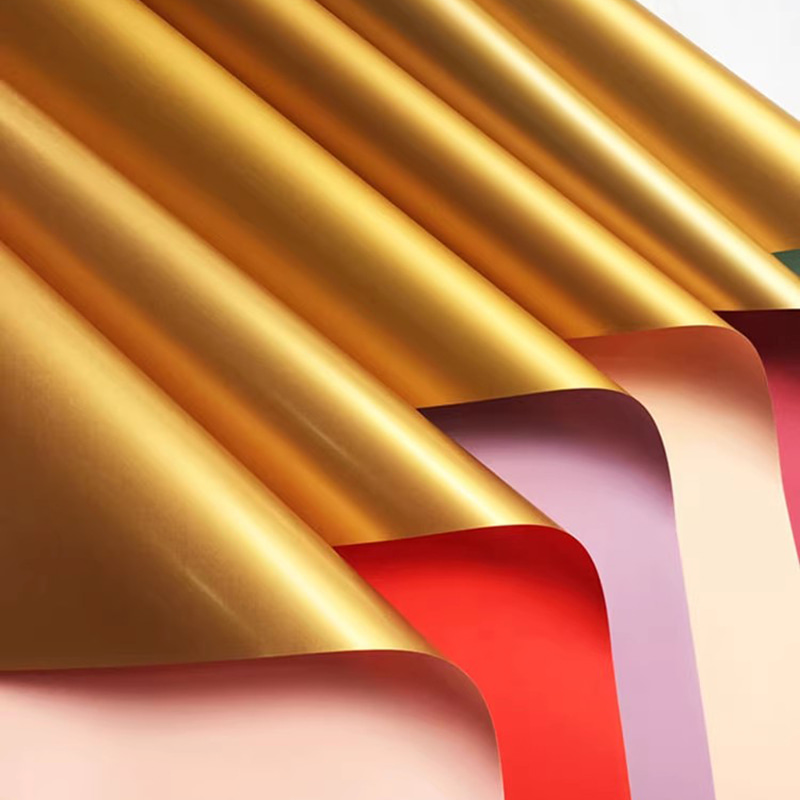 Single-Sided Flash Gold Pearlescent Film Wrapping PaperThis pearlescent film with a shimmering gold finish creates a luxurious, eye-catching effect for premium bouquets. Its crisp folds and elegant sheen make it a popular choice for weddings and special occasions.View Product →
Cost is the main trade-off. Pearlescent films sit at a higher price point than plain kraft or clear film, so they are generally not the first choice for high-volume wholesale floristry. But for shops that charge a premium for special-occasion bouquets, the material cost is easily absorbed into the final selling price.
Matte Film: Subtle Texture, Strong Presence
Matte film is the material that looks expensive without being loud. Its non-reflective surface mutes the paper itself, letting the flowers take visual priority. That makes it a favorite among florists who work with a minimalist brand aesthetic or who wrap high-end single-stem and small-bunch arrangements.
From a technical standpoint, matte flower wrapping film is usually a plastic substrate with a matte coating or a silica-based surface treatment. It is waterproof, and the surface does not stick to itself the way glossy film can, which speeds up handling during wrapping. Transparent matte film is also widely available, offering a frosted-glass effect that partially reveals the flowers while protecting them.
Matte film pairs well with solid-color inner layers. The muted outer surface combined with a brighter inner paper creates contrast without clashing. For florists who have their own branding, matte film also accepts stickers and labels much more reliably than glossy surfaces.
Transparent Film: Clarity That Sells the Flowers
Transparent film is the packaging material that functions more like a display case than a wrapper. Because customers can see the bouquet completely, it is the default choice for markets, convenience bouquets, and any retail context where flower freshness is the main selling point.
There are several sub-categories in this family. High-clarity OPP film is crystal clear and water-resistant; cellophane and glassine have a slightly softer, more natural look; and frosted jelly film offers a translucent, tactile effect between clear and matte. Each produces a different visual relationship between the viewer and the flowers.
One common mistake is relying on transparent film alone with no inner structural layer. Clear film does nothing to support stem weight, and it amplifies the visual chaos of uneven stems. The standard professional approach is to wrap the bouquet in an inner paper layer first, then put the transparent film on the outside. This is also the pattern that photographs best for social media posts.
Waterproof Film: When Protection Comes First
Waterproof flower wrapping film is not a style preference—it is a functional necessity for specific logistics scenarios. Any bouquet that must remain presentable after a delivery ride, a refrigerated cabinet stay, or exposure to rain should have a waterproof outer layer. Standard paper will absorb condensation, wilt, and stain within an hour.
True waterproof film should be distinguished from merely water-resistant paper. A genuinely waterproof material, such as a BOPP film or a PE-coated paper, will hold water droplets on its surface without absorbing them. The term “100% waterproof” on product listings should match what you see when you drip water onto the film in your shop: the water beads up and rolls off rather than soaking in.
Anti-fog treatment is another feature worth evaluating if you store wrapped bouquets in a cold cabinet. Ordinary plastic film develops condensation on its inner surface when the temperature changes. Anti-fog film prevents those droplets from forming, so the flowers are not displayed behind a screen of water. That detail makes a measurable difference in how fresh the bouquet looks at the point of sale.
How to Match Flower Wrapping Paper to Real Use Cases
Once the material properties are clear, the selection process becomes a matching exercise. Here is how the decision logic works in practice for four common business types.
For a retail flower shop with daily walk-in customers, the priority is visual appeal across different flower colors. A base stock of solid-color kraft, one or two printed cotton papers, and a good clear film will cover most days of the year. The transparent film shows freshness; the kraft provides structure; the cotton paper adds a style layer. This combination is inexpensive, easy to rotate, and versatile enough for seasonal shifts.
For a florist focused on wedding and event work, the priority shifts to texture, finish, and consistency across many arrangements. Pearlescent and matte films are the backbone here. Because event orders often require twenty or thirty identical bouquets, choose films with stable color consistency between batches; the last thing an event florist wants is a slightly different shade of pink in the twelfth bouquet compared with the first.
For a delivery-first operation, such as an online floral subscription or a teleflorist service, waterproofing is non-negotiable. The outer layer should be a true waterproof film, and the inner layer should be absorbent enough to handle stem moisture without breaking down. Anti-fog film becomes essential if bouquets wait in a refrigerated space before dispatch.
For a wholesale or market supplier, cost per unit and speed of wrapping are what matter. Standard kraft rolls and OPP film sheets are the default because they are cheap, durable, and available in large quantities. Printed or textured specialty papers are reserved for buyers who request them, not used as standard stock.
| Material type | Common sheet sizes | Typical thickness range | Common roll dimensions |
|---|---|---|---|
| Kraft paper | 50 × 70 cm, 57 × 57 cm | 35–90 gsm | 45–60 cm width × 1–3 m per roll |
| Cotton / tissue paper | 45 × 60 cm, 50 × 70 cm | 17–30 gsm | 45–50 cm width × 1 m per roll |
| OPP transparent film | 57 × 57 cm, 58 × 58 cm | 4.5–7.5 mil (114–190 µm) | 50–60 cm width × 10–100 m per roll |
| Pearlescent film | 57 × 57 cm, 45 × 50 cm | 4.5–7.5 mil | 50–60 cm width × 10–50 m per roll |
| Waterproof coated film | 57 × 57 cm, 58 × 58 cm | 6–10 mil | 50–60 cm width × 10–50 m per roll |
Size, Thickness, and the Practical Impact of Specifications
Paper size and thickness are not minor details. They determine how many wraps you get from a roll, how the paper folds around a bouquet, and whether the finished wrap holds its shape for the couple of hours it is most visible.
The two most common square formats are 57 × 57 cm and 50 × 70 cm. The 57 × 57 cm square is the workhorse size for standard hand-tied bouquets, because the square folds symmetrically into a diamond wrap. The slightly larger 50 × 70 cm rectangle provides more length for tall stems or for wrapping a bouquet diagonally to create a long tail. If your bouquets are consistently large or use long-stemmed flowers, buy the rectangle instead of trying to stretch a square.
Thickness matters for different reasons across materials. For paper products, higher gsm means more rigidity, stronger creases, and better structural support, but it also makes the paper harder to fold into tight curves. Cotton tissue below 20 gsm is almost transparent and tears easily; kraft above 70 gsm begins to feel more like cardboard than paper. For plastic films, the standard measure is mil, where 1 mil equals one-thousandth of an inch. A 4.5 mil film is fine for lightweight everyday wrapping and clear display pouches; a 7.5 mil film is noticeably thicker and more protective, making it appropriate for bouquets that must survive rougher handling.
Do not ignore the consistency of these specifications across shipments. If a supplier’s thickness varies between production batches, your wrapping process will be inconsistent, and your customers will notice. This is particularly important for florists who use automated or semi-automated wrapping stations, where even a 0.5 mil difference can alter folding behavior.
Color and Pattern Strategy for Flower Wrapping Paper
Color is the fastest way to change how a bouquet is perceived. The same white rose bunch reads as rustic in kraft, romantic in cream cotton paper, luxurious in white pearl film, and modern in matte charcoal film. The wrapper sets the emotional context before the customer even looks at the flowers.
Neutral tones—cream, beige, pale gray, and soft brown—are the safest base inventory for most shops because they complement nearly any flower color. Black kraft and deep matte shades are effective for bold, masculine-leaning or night-event bouquets. Pastel shades dominate spring and summer retail, while deeper reds and golds appear more in autumn and Chinese New Year or Christmas seasons.
Printed patterns have their own logic. Newspaper-style prints and English typography continue to sell in the vintage-romantic niche. Polka dots and gingham read as fresh and playful. Floral prints work best when they echo the actual flowers inside the bouquet; a rose-printed wrapper around a rose arrangement reinforces the theme, but a busy pattern around an already colorful bouquet can become visually noisy. Marble patterns and gold-lines have become popular for high-end gift bouquets in recent seasons, and they are available across both kraft and pearlescent film bases.
Environmental Considerations in Flower Wrapping Paper
Sustainability is now a routine procurement question for florists, especially those selling to corporate clients or serving wedding couples who want an eco-friendly concept. The answer is rarely “paper is good, plastic is bad.” The environmental trade-off depends on the material’s base, its coating, its longevity in the customer’s hands, and whether it can be reused or recycled after the flowers are gone.
Kraft and cotton papers without plastic lamination are compostable in principle, which makes them the easiest story to tell an eco-conscious customer. However, uncoated papers remain functional only if the bouquet is short-lived and not exposed to water. Coated and laminated papers offer better protection but complicate recycling because the plastic and paper layers must be separated. Transparent BOPP films are not biodegradable, yet they are widely recyclable as a polypropylene stream, and their durability means a single bouquet wrap can be reused by the customer for another purpose. The full comparison between paper and plastic flower wrapping, including their manufacturing energy and end-of-life scenarios, is covered in more depth elsewhere; the practical point is to decide which environmental claim you are prepared to make honestly. If you state a bouquet is “eco-friendly,” your wrapping material should back that claim up.
B2B Purchasing Considerations: What Florists and Wholesalers Should Check Before Ordering
When you buy flower wrapping paper in commercial quantities, the product quality is only half the equation. The other half is the supplier’s ability to deliver consistently, repeatably, and at a predictable cost. A supplier who can supply a beautiful sample but cannot control thickness consistency across batches will create more problems than one with a slightly less fancy product.
Here are the purchasing checks that prevent the most common supply failures:
- Request a physical sample that matches the exact SKU name and specification you intend to order. Never rely on a product photo alone, because printed floral film looks different on screen than in hand, and the difference in surface feel cannot be communicated by an image.
- Confirm dimension and thickness tolerance. Ask the supplier what their production tolerance is for sheets or rolls, and keep that tolerance in your order specification so you have a legal basis to reject out-of-tolerance goods.
- Check batch-color consistency for heavily dyed or coated materials. A single strong color run can vary between production batches, which becomes a complaint when you reorder six months later.
- Ask the supplier’s MOQ and lead time in writing, and verify whether your reorder price can be locked for a season. Sudden price swings on plastic films can destroy your margins if the supplier is not transparent about raw-material costs.
- Evaluate the breadth of the product range. A supplier with a wide catalog of material families—kraft, cotton, matte, pearlescent, transparent, and waterproof—reduces the number of separate vendors you need to manage. This is worth more than a slightly lower unit price from a one-product supplier.
For florists with an established brand, a supplier that maintains a systematic product numbering structure makes reordering easier. When a specific design is identified by a stable SKU such as “MYHC21,” you can reference the code directly with the supplier, eliminating miscommunication about which pattern you asked for. This kind of operational detail matters more for long-term efficiency than any single material’s aesthetic appeal.
Combining Wrapping Materials with Accessories
Wrapping paper does not work alone. The finished bouquet usually includes an inner layer, an outer layer, a ribbon or tie, and sometimes additional elements such as mesh, a wrapping bag, or floral foam for hydration. Choosing the paper without considering these companions is like choosing a paint color without looking at the room’s furniture.
The most common professional build is an inner layer of cotton tissue for softness and moisture absorption, an outer layer of kraft or film for structure and presentation, a ribbon or twine to secure the wrap, and a transparent film or wrapping bag over everything to protect during transport. This is not the most creative structure, but it is the one that balances cost, speed, and reliability for daily retail work.
For premium bouquets, the inner layer becomes a contrasting color that peeks out from behind the outer film, and the tie becomes a deliberate design element rather than a functional afterthought. Ribbon width, texture, and finish contribute as much to the final look as the paper does. Wholesale buyers should also keep in mind that flower wrapping paper, floral foam, wrapping bags, and ribbon are generally bought from the same suppliers in commercial practice, so the total package cost matters more than the paper alone.
The best flower wrapping paper is not the most expensive or the most popular one on social media. It is the material that fits your bouquet’s flower type, delivery route, shop aesthetic, and unit-cost target. Kraft is a reliable structural choice, cotton tissue brings softness and photography-friendly texture, pearlescent and matte films convey event-grade polish, transparent film sells freshness, and waterproof film protects when protection is what matters.
Start by defining your most common bouquet scenario, select two or three materials that fit it, and set up a simple testing routine: wrap ten bouquets, send them through your normal handling and delivery process, and look at the result at the customer’s hands rather than at your work table. The paper that still looks good after real-world conditions is the right paper for your business.
 +86-18270363850
