 English
 русский
 عربى
عربى


add: North of Gaoxin North Road, east of Jinyun Road, Wannian High-tech Zone, Shangrao City, Jiangxi Province
A bouquet is only as good as the paper that carries it. The wrapper has to protect the stems, support the flower heads, survive the trip from shop to recipient, and still look like part of the gift. That is a lot to ask from a single sheet, which is why florists, wholesalers, and event planners keep coming back to the same question: what type of paper is best for wrapping flowers?
The short answer is that the best material depends on the flowers themselves, how long they will be out of water, and the look the customer expects. The more useful answer breaks the decision into a few practical parts. Match the paper's water resistance to the stems, match its transparency to how much of the flower head you want to show, and match its texture to the occasion. Do those three things and almost any quality paper can be the right one.
Before looking at specific materials, it helps to see how the main options behave in real shop conditions. For style-oriented decisions, our article on choosing wrapping paper for every occasion explains how colours and patterns interact with different blooms.
The Main Families of Flower Wrapping Material
Commercial wrapping materials divide into four families: cotton tissue paper, kraft paper, plastic films such as BOPP and cellophane, and coated decorative films. Each family has a distinct profile of water resistance, stiffness, transparency, and printability, and most suppliers build their catalogue around these differences.
Cotton tissue paper
Cotton tissue is a soft, matte, slightly textured paper that absorbs water rather than repelling it. Used alone, it will stain quickly when it meets wet stems, so florists either dry-pack the bouquet or place a waterproof inner layer beneath it. Its strength is presentation: it folds into soft, rounded shapes, accepts dye and printing beautifully, and gives a natural, handcrafted feel. The category includes single-sided polka-dot designs, two-colour aluminium-plated cotton films, and simple border styles. If the bouquet will be handed over within a few hours and you want a gentle, organic silhouette, cotton tissue is the best place to start.
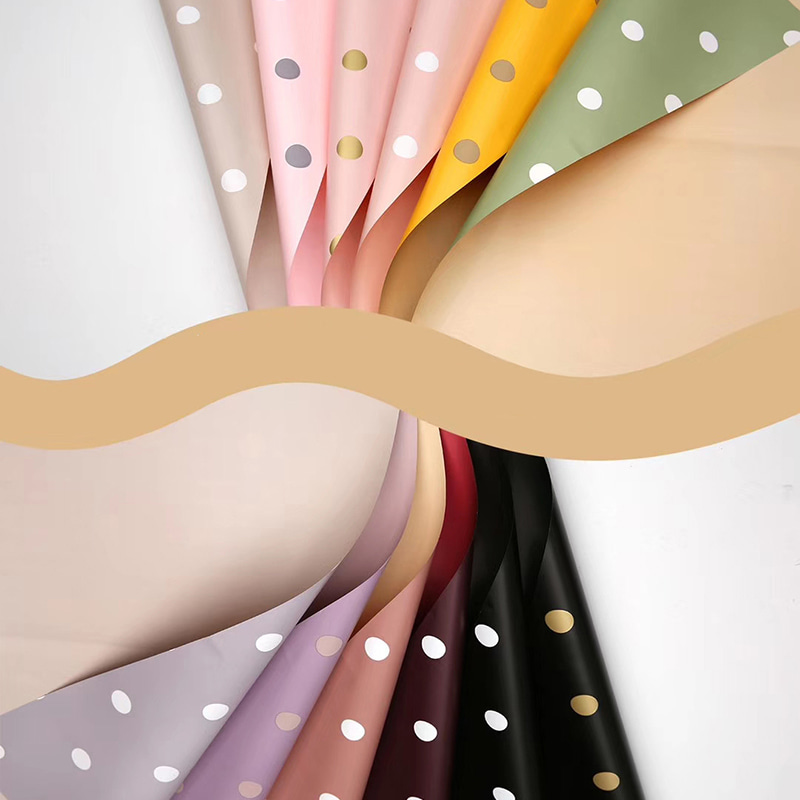 MYHC-24 Single-Sided Polka Dot Cotton Flower WrapThis soft, matte cotton paper with playful polka dots suits dry-packed bouquets handed over within hours, adding a natural, handcrafted feel while doubling as a decorative element for modern floral arrangements.View Product →
Kraft paper
Kraft paper is the everyday workhorse of floristry. Thicker and stiffer than cotton tissue, it holds a crisp fold, shields stems from knocks, and projects a rustic, vintage charm that suits many modern shops. Standard kraft has low water resistance, but many commercial kraft products are laminated or coated on one side with a plastic film, giving you the paper look with a waterproof backing. Kraft also accepts printed graphics extremely well, which is why newspaper-style prints, English text patterns, line-drawn hearts, and gradient kraft sheets are so widely available. Use kraft when the bouquet needs structure, a casual aesthetic, or a lower-cost wrap that still feels considered.
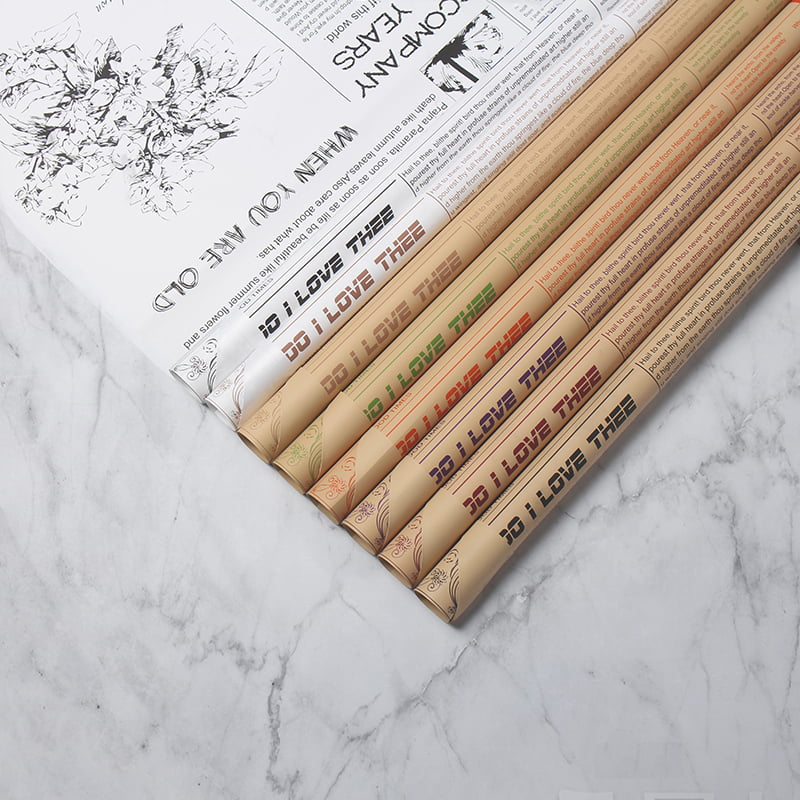 MYHC-21 Retro Newspaper Style Kraft Flower WrapThis stiff kraft paper with a vintage newspaper print holds crisp folds and protects stems, delivering rustic charm for bouquets that need structure and a personalized, culturally rich statement.View Product →
BOPP film and cellophane
Plastic films solve the two problems that paper cannot: they keep the water in and keep the paper dry. BOPP film is the material often sold as Korean wrapping paper. It is crisp to the touch, available from fully transparent to heavily printed, and can be produced in solid colours, metallic finishes, and patterned designs. Because it is waterproof, BOPP is the default for bouquets that travel in a delivery vehicle, sit in a refrigerated cabinet, or go out in rainy weather. Cellophane plays a similar role with a clearer, glass-like appearance that shows off the flower heads. The weakness of plastic films is condensation: when wet stems are wrapped tightly in an airtight film, moisture collects as fog inside the sleeve, so anti-fog coated films are the practical fix for cold-chain routes.
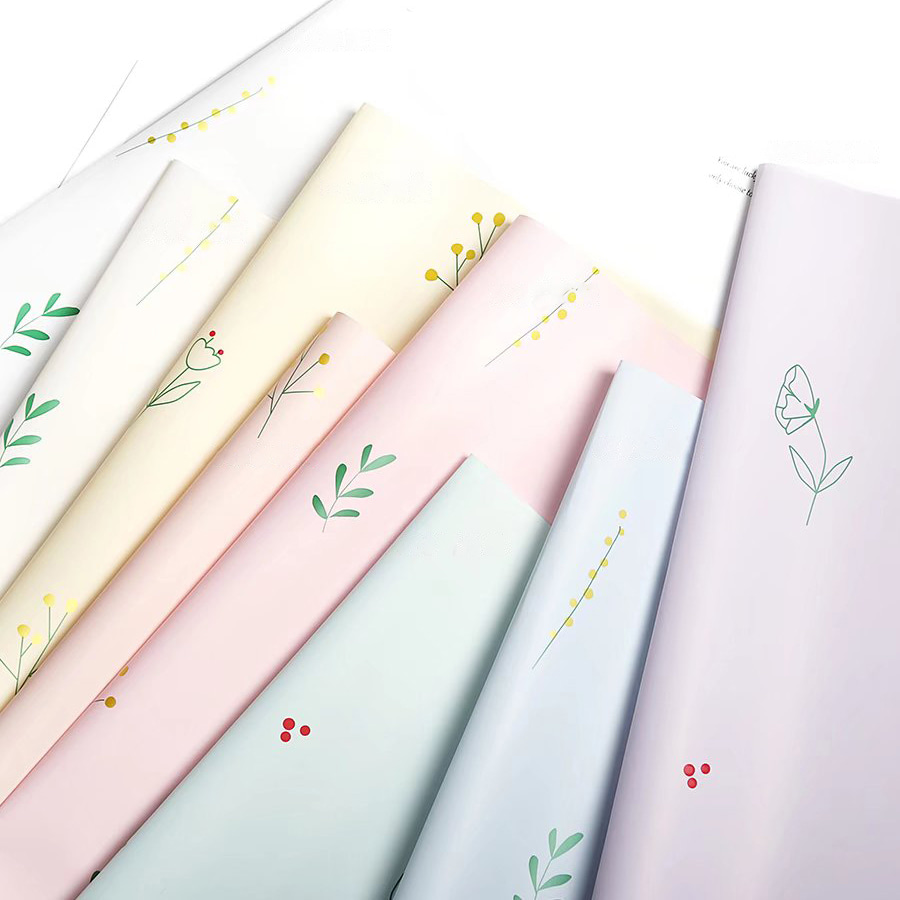 Anti-Fog Moisture-Proof Plastic Bouquet Packaging FilmThis 58cm by 58cm film prevents condensation fog during cold-to-warm transport, keeping wrapped bouquets clear and fresh. Its moisture barrier locks in flower hydration, ideal for delivery and display.View Product →
Pearlescent, matte, and waterproof decorative films
For premium bouquets, coated films give florists control over both texture and performance. Matte film mutes reflections and feels smooth, which photographs well and reads as sophisticated. Pearlescent film adds a soft shimmer without being loud, and details like gold edges, embossing, and printed florals turn the wrapper into a decorative element in its own right. The important upgrade in this group is a waterproof coating: it keeps the matte or pearl finish while shedding water, so a shop can display a wet bouquet without worrying about stains, and a wedding bouquet can be carried for hours without the wrapper deteriorating. Because the coating is applied in production, water resistance stays consistent even across large batches.
The table below summarises how the main materials compare on the criteria florists check first.
| Material | Water resistance | Visual character | Typical use |
|---|---|---|---|
| Cotton tissue | Low | Soft, matte, natural | Hand-tied and garden-style bouquets |
| Kraft paper | Low to medium, coated options available | Rustic, vintage, printed | Everyday retail bouquets and eco-friendly presentation |
| BOPP film / cellophane | High | Glossy, transparent or printed | Delivery bouquets and refrigerated display |
| Pearlescent / matte film | Varies, often waterproof coated | Shimmer, elegant or muted | Weddings, events, and gift bouquets |
Matching the Wrap to the Flowers, the Journey, and the Occasion
The practical method is to work from the inside out. Look at the stems first: if they are wet, the layer that touches them must be waterproof, or the paper will stain. Then look at the journey: a bouquet that stays on a counter needs less protection than one that rides in a van for two hours. Finally, consider the customer's expectations. A wedding client notices the finish; a delivery recipient cares that the flowers arrive intact; a market shopper may ask whether the wrap can be composted.
- Same-day counter display — use cotton tissue or a matte film over a waterproof inner sheet, so you get the soft look without the stain risk.
- Local delivery — choose BOPP or cellophane for water resistance, and request anti-fog film if the order travels refrigerated.
- Weddings and events — pick pearlescent, gold-edged, or embossed film where the wrapper will appear in photographs and needs to look deliberate.
- Eco-conscious customers — use plain kraft or cotton tissue without a plastic liner when the bouquet stays local and is unwrapped quickly.
Buying Considerations for Florists and Wholesalers
In commercial purchasing, three specifications determine whether a wrapping paper is right for your operation: sheet size, thickness, and the consistency of the finish across batches.
- Sheet size: 57 × 57 cm and 58 × 58 cm are the standard squares for retail bouquets; 45 × 50 cm suits smaller arrangements, and larger sheets reduce waste at events.
- Thickness: plastic films are often specified in mils, with 4.5 mil light and flexible and 7.5 mil heavier, while paper is judged by feel and fold; always compare samples.
- Print and coating consistency: double-sided prints, metallic laminations, and waterproof coatings must match from batch to batch, so order a pre-production sample before a large order.
- Packing format: flat sheets move quickly on a wrapping bench and take up less shelf space, while rolls suit high-volume operations that cut to size.
A complete overview of the available material families, from transparent films to coated kraft, is on our flower wrapping paper and film category page.
Eco-Friendly and Compostable Options
Sustainability questions come up more and more at the counter. Plain kraft and cotton tissue are biodegradable and easy to explain to customers, but they have the same limitation: without a liner, wet stems will mark them. For daily local sales this is acceptable, because the bouquet is unwrapped quickly. For customers who need moisture protection but want to reduce plastic, coated kraft and recyclable BOPP sit in the middle. Avoid calling a laminated or coated paper compostable unless the supplier provides documentation, because the coating changes how it degrades. A practical compromise is to use a small waterproof inner sleeve and a kraft or cotton outer layer, so the visible material gives the eco impression while the functional part stays protected.
The Best Paper in Practice
No single material wins every order, and the most efficient shops do not try to pick one. They layer: waterproof or coated film inside when stems are wet, cotton tissue or kraft outside when the style calls for a natural look, and pearlescent or matte film for occasions where the wrapper has to perform visually. Start with the flowers and the journey, then add the finish that matches the customer.
That approach removes most of the guesswork. If the paper survives contact with water, holds the shape of the bouquet, and fits the style of the occasion, you have chosen correctly — and a supplier that can maintain that standard across every batch is worth more than a single perfect sheet.
 +86-18270363850
