 English
 русский
 عربى



add: North of Gaoxin North Road, east of Jinyun Road, Wannian High-tech Zone, Shangrao City, Jiangxi Province
Watch a florist pack a bouquet in a shop with a glass-front cooler and you will see the decision that matters most happen in about four seconds: the hand reaches for a roll, tears a sheet, and folds it around wet stems. If that wrap is the wrong build, the bouquet looks tired by the time it reaches the customer. Not because the flowers were bad, but because the paper at the fold line took on water, softened, and let the whole silhouette collapse.
The short answer first. Waterproof wrapping paper for flowers should be chosen by where the water sits and how long it stays there, not by the word printed on the carton. Three things decide the outcome: whether the barrier is a continuous plastic film or a coating applied to paper, whether the treated side actually faces the moisture, and whether the folds and edges of the finished wrap are protected. A sheet that shrugs off a splash can still fail a six-hour delivery in a humid van.
The rest of this guide works through those three points in the order a buyer meets them — what the claim means, which build suits which water source, what the numbers on the spec sheet should say, how print and lamination interact with wet stems, and what to check before you commit to a container load. It is written for people who order this material by the roll or the carton and hear about it when something goes wrong at the shop counter.
What a Waterproof Claim Actually Covers
Suppliers use "waterproof" for at least four different constructions, and they behave nothing alike. Confusing them is the single most common reason a florist ends up with wrap that feels premium in the hand and disappoints in the cooler.
| Build | How it blocks water | Typical flower use | Where it fails first |
|---|---|---|---|
| Plain plastic film (OPP, BOPP, cellophane-type) | A continuous polymer sheet with no absorbent fibre at all | Outer layer on transport bouquets, cooler display, market bunches | Creases turn into pinholes; static makes it cling and tear at the top edge |
| Film-laminated paper | Paper core bonded to a thin plastic or matte film layer | Gift and premium bouquets where both hand-feel and protection matter | Delamination along cut edges and foil-stamped areas |
| Coated paper (water-based, PE or similar dispersion coating) | A thin barrier layer on one or both faces of a paper sheet | Printed designer wraps, cotton- and kraft-look papers | Pinholes in the coating; uncoated reverse side wicks from the inside |
| Repellent-treated paper (wax or fluorocarbon-free repellents) | Fibres resist wetting rather than being sealed | Rustic and natural-look wraps, short display windows | Prolonged contact with free water; repeated folding along the same line |
The distinction has a practical consequence for ordering. A film-laminated sheet and a coated sheet can carry identical printed patterns, identical 57 × 57 cm dimensions and a nearly identical price per sheet, yet one will survive a wet bucket and the other will not. If the purchase order only says "waterproof, printed, 57 cm", the supplier is free to ship whichever of the two the line happens to be running.
The Barrier Is Only as Good as Its Weakest Line
Water almost never crosses a wrap in the middle of a panel. It crosses at an edge, a crease, a staple, a taped seam or a punched hole. That is why two florists using the same paper can report opposite results: one folds a crisp double edge that keeps free water away from the cut line, the other gathers the sheet loosely so water pools in a soft crease and sits there.
Cut edges deserve particular attention. Shears compress the coating and can micro-crack it along the cut, and on film-laminated stock the paper core is exposed in cross-section like a wick. On a ten-minute hand-off this is invisible. On a bouquet that sits in a cooler for three days with a damp sleeve pressed against that edge, it shows up as a dark tide line that climbs two or three centimetres up the sheet.
One-Sided Coating Is a Different Product, Not Half the Protection
A sheet coated on one face only is not simply weaker than a sheet coated on both. It is directional, and it fails in a different place. With the coated side out, ambient condensation and rain run off, while vapour from the stems passes through the paper and escapes. With the coated side in, the sheet blocks water from the stems but drinks whatever the cooler throws at it.
For florists, the practical rule is that the coated or filmed face should point at the water source you actually have. A bouquet standing in a bucket needs the protection on the inside. A bouquet travelling in a humid van with no water source other than the sleeve needs it on the outside. When both exist — which is most retail work — the honest answer is either a double-coated sheet or a two-layer wrap, and the specification should say so in those words.
Matching the Wrap to Where the Water Is
Before choosing a material, list the water sources in your own workflow. Most shops have three or four, and they are rarely the ones assumed at purchase time.
- Free water in the bucket, wicking upward through the stems and into the paper sleeve
- Condensation inside a glass-front cooler, which forms on the cold wrap surface and runs down
- Wet floral foam pressed against the inner layer during assembly
- Rain or drizzle during delivery, arriving on one face of the wrap only
- Hands and work surfaces, transferring moisture at the exact point where the sheet is folded
The same shop may need two different wraps: a film or film-laminated sheet for cooler and delivery work, and a coated printed paper for bouquets that leave the shop within the hour and are photographed on the counter. Trying to make one product cover both is where most material complaints begin.
| Water source | What to specify | Why it holds up |
|---|---|---|
| Bucket standing water, long display | Double-sided waterproof film, 4.5 mil or heavier | No fibre to wick; the sheet stays dimensionally stable when wet |
| Cooler condensation | Anti-fog treated film, or a matte laminated sheet | Reduces droplet beading that scatters light and spots the print |
| Wet foam contact | Film-laminated paper with the film facing the foam | The plastic layer interrupts direct contact between wet foam and paper fibre |
| Rain during delivery | Double-coated paper or an OPP outer sleeve | Both faces resist, so orientation errors during packing do not matter |
| Short hand-off, dry stems | Coated printed paper, single side | Enough protection for the display window; better print and drape |
Films deserve a separate note on anti-fog behaviour, because it is the property buyers notice last and complain about most. Plain OPP in a cold case collects fine droplets within an hour. They scatter the light, blur the flower colour and, in a photograph, read as a dirty sheet. An anti-fog additive changes the contact angle so condensation spreads as a thin film instead of beading. The difference between the two films is invisible on a sample board at room temperature and obvious on the second morning in a cooler.
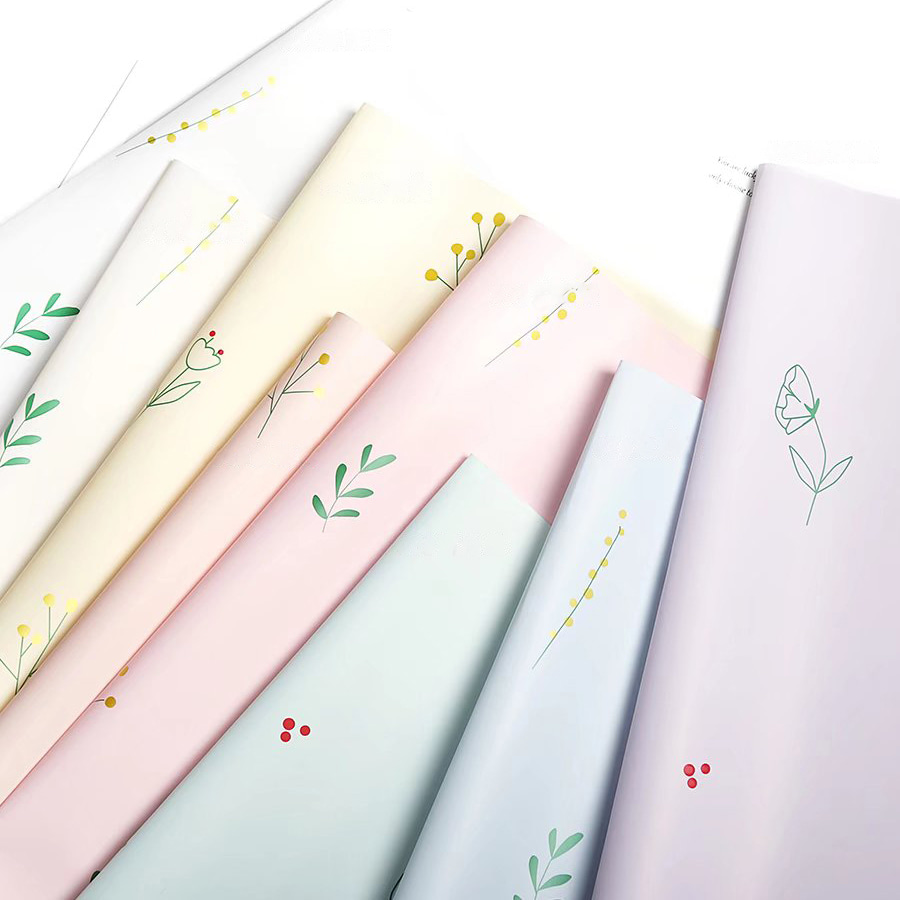
 100% Waterproof Six-Color Flower Packaging FilmA six-color, 58x58 cm waterproof film for shops that want one wrap for cooler display, delivery and market work.View Product →
Where a shop needs one product to cover cooler display, delivery and market work, a fully waterproof film in a small colour range is usually the least risky single choice. It removes the orientation question entirely, because there is no untreated face, and it survives the fold-and-refold cycle that hand-tied bouquets go through when they are reworked on the counter. The trade-off is drape: a film is crisper than a soft cotton sheet, so the bouquet silhouette becomes more architectural and less relaxed. If a shop's style language is loose and natural, that is a real cost, not a technicality.
Thickness, Width and the Numbers Worth Asking For
Specifications on flower wrap are written in a mix of units that do not convert comfortably in the head, and suppliers publish them inconsistently. A buyer who cannot convert cannot compare. The three measures that matter are gauge, sheet or roll dimensions, and grade for paper-based stock.
Gauge: Mils, Microns and What They Mean at the Fold
Film thickness is quoted in mils (thousandths of an inch) or microns, and the two are often mixed on the same price list. One mil is 25.4 microns, which gives the following working equivalents:
- 3 mil ≈ 76 microns — light, high-clarity wrapping film, best for short display and gift wrapping where drape matters more than strength
- 4.5 mil ≈ 114 microns — the common middle grade for bouquet outer layers and general florist work
- 7.5 mil ≈ 190 microns — heavy film for transport, market bunches and any bouquet that is folded, taped and stacked
The practical effect of gauge is not stiffness in the hand. It is how the sheet behaves at a sharp fold. Light film creases cleanly once and then splits when the same line is folded back. Heavy film holds the crease, resists the split, and keeps the wrap standing away from the flowers instead of sagging against the petals. For anything that travels in a box or a stacked crate, the heavier grade usually pays for itself in reduced rework, even at a noticeably higher sheet cost.
Sheet and Roll Dimensions
Common sheet sizes in this category run to 57 × 57 cm, 58 × 58 cm and 45 × 50 cm, with a trimmed edge band of roughly 2 cm on some printed lines. Roll formats typically pair a 58 cm width with a longer continuous length, and the core diameter is worth checking because it determines whether the roll fits the dispenser or wall bracket the shop already owns.
Two small details cause disproportionate aggravation. First, a nominal 57 cm sheet can measure 55.5 cm and still be within a supplier's stated tolerance; across a hundred bouquets that difference changes the number of sheets per bouquet and quietly breaks a costing model. Second, the trimmed edge band on printed paper is often decorative rather than structural, and a shop that folds along it instead of past it will see cracking on exactly the products with the most elaborate edges.
Why a Five Percent Gauge Difference Shows Up as a Crease
Thickness tolerance sounds like a factory concern until a wrapping session is underway. A batch running five percent light feels fine on the roll but folds with less spring, so the same hand motion produces a softer corner and a wrap that leans inward. Staff compensate by adding tape or a second layer, which consumes material and time, and the bouquet looks bulkier than the sample that was approved.
For paper-based wraps, the equivalent number is grammage. Cotton and kraft-look flower papers are commonly quoted in a range rather than a single figure, and a low grammage sheet with an impressive print will feel substantial on the sample board and go limp against a damp sleeve. Ask for the range, ask what the tolerance is, and ask whether the coated version of the same design carries the same base weight. It frequently does not.
Print, Coating and the Cost of a Beautiful Mistake
The most expensive failures in flower wrap are not about water getting through. They are about water getting in and the decoration coming off. Gold edges, foil-stamped motifs, deep embossing and matte laminations all change how a sheet behaves when it is wet, and none of them are captured by the word "waterproof".
Foil and metallic stamping sit on top of the surface rather than inside it. Under repeated moisture and handling, the foil edge lifts, and once one corner lifts the sheet looks damaged even where the barrier is intact. Embossed patterns create valleys in the surface where water collects, and if the embossing was applied after coating rather than before, it can press through the barrier at the deepest points. Matte lamination gives a soft, premium hand-feel, but the lamination layer is a film in its own right, and a cheap adhesive at the boundary is where delamination starts on a cut edge.
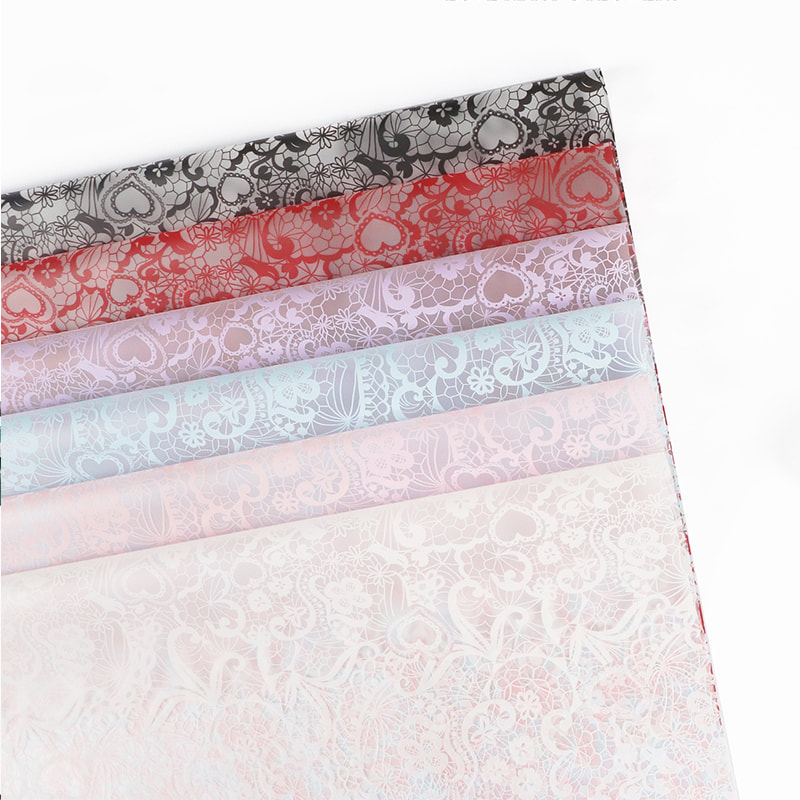
 Embossed Matte-Laminated Waterproof Flower Wrapping PaperA medium-thick 58x58 cm plastic wrap with embossed texture and matte lamination for bouquet presentation, packed 20 sheets per bag.View Product →
Embossed, matte-laminated waterproof paper is a good example of a product that has to be judged as a system rather than a material. The embossing supplies the texture, the matte lamination supplies the surface durability, and the base sheet supplies the stiffness that keeps the bouquet shape. If any one of the three is downgraded to hit a price point, the sheet will still look correct in a photograph and will still be described as waterproof, but the embossed relief will flatten under a damp hand and the corners will soften within a day.
Three Tests a Buyer Can Run in Ten Minutes
- Water drop test: place a coin-sized drop on the treated face, leave it thirty minutes, then blot and inspect. A ring or a darkened halo on the reverse means the barrier is incomplete or the sheet is oriented wrong.
- Fold-and-soak test: fold the sheet as the shop folds it, stand the fold in 5 mm of water for an hour, then unfold. Cracking along the fold and a soft, pulpy edge are early warnings of field failure.
- Tape test on print: press ordinary clear tape onto a printed or foiled area, smooth it down, then pull at a shallow angle. Lifted ink or foil means the surface treatment and the decoration are not properly bonded, and moisture will accelerate the same failure.
None of these tests replace a proper lab report, and none of them should be treated as a specification. What they do is catch the mismatch between a sample and a production batch before a shop commits a season's worth of shelf space to it.
A Wrapping Sequence That Keeps Water Where You Want It
Material choice sets the ceiling on performance; the wrapping sequence decides how close to that ceiling a shop actually operates. The order below is written for a hand-tied bouquet that leaves the shop wet and travels for several hours.
- Trim and hydrate. Cut stems, condition them in clean water, and let them drink before any wrap goes on. Sealing a dry stem inside a waterproof sheet does nothing for vase life and traps air that later condenses.
- Blot the stem ends and the first two centimetres. Free water on the outside of the stems is what wicks into paper edges. A single pass with an absorbent towel removes most of the risk at almost no labour cost.
- Add the hydration layer first. A damp cotton or tissue layer close to the stems holds moisture where the flowers need it and keeps that moisture away from the outer decorative sheet.
- Place the waterproof layer with the treated face toward the water. If the sheet is single-sided, this is the step where orientation errors happen, so it is worth marking the untreated face at the roll or keeping single-sided stock for dry hand-off work only.
- Fold a hard double edge along the bottom. A crisp fold with two thicknesses resists wicking far better than a soft gather, and it gives the bouquet a flat base that stands upright in a bucket or on a counter.
- Leave the top open. A completely sealed waterproof package traps transpired moisture, fogs the film from the inside and, in warm conditions, invites botrytis. Air exchange at the top is a feature, not an oversight.
- Finish with ribbon and any mesh or accessories, and keep the tie above the water line. A ribbon tied through a wet fold wicks moisture upward and leaves a stain that reads as poor quality.
Steps two and four are where most of the practical gain sits, and both are close to free. A shop that blots stems and orients single-sided sheets correctly will often outperform a shop using a more expensive double-coated product with a careless sequence. That is worth remembering when a material complaint turns out to be a method problem.
The Procurement Checklist
Buying flower wrap at volume is a specification exercise with a short feedback loop: either the bouquets look right on Saturday or they do not. The checklist below is organised around the failures that repeat most often across orders, rather than around the categories suppliers like to quote.
| Point to confirm | Why it matters in a flower shop | How to verify |
|---|---|---|
| Base material and barrier type | Determines whether the sheet resists free water or only light splashes | Written confirmation of film, lamination or coating, not just "waterproof" |
| Which face is treated | Single-sided stock fails when packed the wrong way round | Marked samples, or a packing instruction in the carton |
| Gauge or grammage with tolerance | Batch-to-batch variation changes fold behaviour and sheet count per bouquet | Measured sample from the delivered batch, not the approved sample |
| Cut dimensions and edge band | Affects yield per bouquet and whether decorative edges crack | Measure ten sheets from the middle of the carton |
| Print and foil adhesion | Decoration lifting under moisture looks like a defect to the customer | Tape test on delivered stock |
| Roll core and packing format | Core size decides dispenser fit; flat-packed sheets crease in transit | Check against existing brackets and storage height |
| Colour consistency across batches | Two dye lots in one shop window is immediately visible | Retain a signed reference sample and compare each delivery |
| Storage conditions and shelf life | Coated and laminated stock degrades in damp storage before use | Ask for the recommended humidity range and reorder cycle |
Two of these deserve more than a line. Colour consistency is the classic hidden cost of splitting an order across production runs: the second container matches the specification but not the first container, and a shop window with two slightly different reds looks careless even to customers who could not name the difference. Retaining a signed reference sample and comparing a sheet from each delivery under the same light is a five-minute habit that prevents a season of quiet irritation.
Storage is the other. Laminated and coated papers are stable in a dry stockroom and vulnerable in a damp back room next to a walk-in cooler. Sheets that have absorbed ambient moisture before use will crease differently, print less crisply and fail sooner, which is why some material complaints are really building complaints. Keeping stock off the floor, in the original carton and away from the cooler wall costs nothing and removes a whole class of failure.
Cost per Bouquet: A Small Calculation With Real Numbers
Material decisions are usually argued on price per sheet, which is the least useful number in the room. Cost per finished bouquet is what reaches the accounts, and it moves for reasons that have nothing to do with the invoice.
Take a shop making sixty bouquets a week. Suppose the current wrap yields four bouquets per sheet at a sheet cost that works out to a small fraction of the retail price, and a heavier waterproof film would yield the same four bouquets at a visibly higher sheet price. On the invoice, the heavier film looks like an unnecessary upgrade. Now add the rework: with the lighter sheet, perhaps one bouquet in twelve needs a second sheet because the first tore or sagged at the fold, and one in twenty needs a partial re-wrap after delivery. That is roughly eight extra sheets and about twenty-five minutes of labour per week, plus the occasional replacement bouquet when a wrap fails visibly in front of a customer.
Set the eight extra sheets and the labour against the price difference on sixty bouquets and the heavier film is frequently the cheaper option — not by a wide margin, but reliably. The calculation flips back if the shop only makes dry, short-distance hand-offs, which is exactly why a single blanket answer to "which waterproof wrap should we buy" is unhelpful. The number depends on the workflow, and the workflow differs between a cooler-based retail shop and a market stall.
There is a third cost that rarely appears on a spreadsheet: the photograph. A wrap that fogs, spots or sags produces a bouquet that photographs badly, and in a business where most first impressions are digital, a material saving that costs image quality is not a saving. Anti-fog films and matte laminations are partly bought for this reason, and it is a legitimate one.
Disposal, Reuse and the Questions Customers Ask
Waterproofing and recyclability pull in opposite directions, and flower wrap sits right at the tension. A continuous plastic film resists water because it resists everything, including the water-based processes used to break material down. A coated paper sheet resists water on its surface but is often rejected by paper recyclers once the coating or lamination passes a certain proportion of the sheet weight.
The honest framing for a florist is to separate the two layers. Where the wrap has to survive a cooler and a delivery van, a plain polypropylene film is a defensible choice because it is mechanically recyclable in the streams that accept PP and because it uses very little material for the protection it gives. Where the wrap only has to look right for an hour, an uncoated or lightly coated paper that can go into ordinary paper recycling is the better answer, even though it would fail the cooler test.
The detail that matters most in practice is contamination. A paper wrap with a soaked, food-stained interior and a ribbon taped to it is not recyclable regardless of what it is made from. Shops that want to make a credible claim should keep the material mono-material where possible, avoid heavy foil coverage across the whole sheet, and tell customers plainly which bin the wrap belongs in. For a longer comparison of the trade-offs between plastic and paper options in this category, the site's guide to plastic versus paper flower wrapping covers the same decision from a materials angle.
Reuse deserves a mention because it is where florists have the most credibility and the least documentation. A sturdy waterproof film outer layer can be peeled off, wiped and reused by the customer as a gift-wrap or a protective sleeve, and saying so out loud is more persuasive than a recycling logo that depends on a municipal stream the customer cannot verify. Claims that cannot be verified are the ones that damage trust when a customer asks a direct question.
Where a Specialised Supplier Fits Into This Decision
Most of the choices above come down to knowing exactly which build is in the carton, and that is a supply-chain question as much as a product one. A manufacturer that produces both the film-based and the paper-based side of the category can quote the barrier type, the treated face and the gauge in the same document, which removes the guesswork described earlier.
Jiangxi Lixuan New Material Technology, trading as lixuanflowerwraps.com, sits at the packaging consumables stage of the flower chain rather than in growing or retail. Its range is organised around the bouquet as a finished object: the waterproof flower wrapping paper and film category covers double-sided, pearl, matte and printed waterproof builds, and the wider catalogue adds bags, mesh, ribbon, accessories and floral foam so that a shop can source a complete wrapping system rather than assemble one from four suppliers.
The company describes automated production lines as its main control on consistency, which is the right thing to care about for this product: a waterproof sheet is only useful if the tenth carton behaves like the first. Its product naming carries a continuous MYHC development sequence across cotton, kraft, matte, pearl, plastic, transparent and waterproof families, and that breadth is the practical advantage for a buyer — a shop can move from a cooler-grade film to a printed matte sheet for a wedding order without changing supplier, packing format or reorder process.
 Anti-Fog Moisture-Proof Plastic Bouquet Packaging FilmA 58x58 cm plastic bouquet film with anti-fog and moisture-proof properties, useful where cooler condensation can blur flower color and presentation.View Product →
Anti-fog and moisture-proof film is the clearest illustration of why the category needs a specialist rather than a general packaging merchant. The additive that spreads condensation into a thin film instead of beads is a small formulation detail with a large effect on how a bouquet looks under glass, and it is invisible in every photograph and most spec sheets. Buyers who ask about it, and who test for it, tend to be the ones who stop receiving complaints about the cooler window.
Delivery capability is worth confirming rather than assuming. The company is based in Wannian County, Shangrao, Jiangxi, with road access into regional flower distribution networks, and it presents fast response from design through production and logistics as one of its operating strengths. Specific capacity figures, lead times and freight partners are not published on the site, so they belong in the enquiry rather than in the plan. For a shop testing a new wrap, that conversation should include a sample of the exact production batch, the reference sample to hold against future deliveries, and a written statement of the barrier type and treated face.
Coming back to the four-second decision at the start: the florist reaching for a roll is not choosing a colour or a pattern, they are choosing how the next eight hours will go for that bouquet. The wrap that works is the one whose barrier matches the water in the workflow, whose treated face points the right way, whose edges and folds are folded rather than gathered, and whose gauge or grammage is consistent enough that the tenth carton behaves like the first.
None of that requires a laboratory. It requires a written specification, a retained sample, three simple tests and a wrapping sequence that keeps free water away from cut edges. Shops that put those four things in place usually stop arguing about whether a particular paper is "really waterproof" and start arguing about more useful questions, such as which finish photographs better against this season's palette — which is a far better use of the four seconds.
 +86-18270363850

