 English
 русский
 عربى



add: North of Gaoxin North Road, east of Jinyun Road, Wannian High-tech Zone, Shangrao City, Jiangxi Province
A flower market buyer once put two swatches side by side on the counter, both sold as "matte black bouquet film, 58 by 58 centimetres," and asked which was the better value. One tore cleanly along a fold. The other split down the crease before the day was out. Same description, same nominal size, almost the same price per pack. The difference was roughly two mil of thickness and whether the matte surface was a coating or a laminated layer.
That comparison is the short version of everything below. With flower bouquet wrapping materials, the specification decides the outcome, not the adjectives. Thickness governs how a wrap takes a crease and whether a cone stands up on the bench. Coating governs whether a droplet beads on the surface or soaks through to the liner. Print registration governs whether a rose motif can be centred on a cut sheet without a stem slicing through it. None of that appears in a supplier's headline description, and all of it shows up in the shop.
So the working order is: choose by the bouquet's journey first, by the finish second, and by unit price third, then check that the numbers on the spec sheet actually support what the sample promised. The sections that follow walk through that order, from the four layers of a commercial bouquet wrap, through GSM and mil conversions, waterproof and anti-fog behaviour, print and edge finishing, size and yield arithmetic, colour matching across batches, the accessories that finish a wrap, sustainability verification, supplier vetting, and how to structure a buying programme that does not end up as a shelf of half-used trend prints.
Start With the Four Layers, Not the Paper
Shops that buy wrapping materials by browsing paper swatches tend to end up with a drawer of beautiful outer sheets and no plan for what sits underneath them. A commercial bouquet is a stack, and each layer in the stack does a different job. Get the stack right and almost any outer design will work. Get it wrong and the most expensive sheet in the catalogue will look flat and slightly sad.
The four layers are the outer wrap, the inner liner, a protective barrier where water or cold is involved, and the finishing hardware: ribbon, mesh, pins, bags, and foam. The first two are visual, the third is functional, and the fourth is what most customers unconsciously judge first, because it is the part their hands touch.
| Layer | Job it does | Common materials | Spec worth checking | Failure symptom |
|---|---|---|---|---|
| Outer wrap | Sets the silhouette and carries the design | OPP and BOPP film, matte laminated paper, kraft, cotton | Thickness in mil or micron; fold retention | Cone collapses in the van; creases crack along the fold |
| Inner liner | Softens the shape, adds contrast, hides stems and mechanics | Cotton and tissue paper, pearl film, translucent matte film | GSM; opacity; colour fastness | Stems visible through the liner; liner colour shifts the outer wrap |
| Protective barrier | Keeps water off the outer layers and controls condensation | Waterproof-coated film, anti-fog OPP, double-sided coated paper | Coating coverage; anti-fog treatment; shelf life | Water marks on the outer sheet; fog droplets staining petals in the cooler |
| Finishing hardware | Closes the wrap, adds perceived value, carries branding | Satin and grosgrain ribbon, mesh, pins, carrier bags, floral foam | Ribbon width and weave; mesh width; foam absorption rate | Ribbon slips on glossy film; mesh tears at the knot; foam crumbles |
Two practical consequences follow from that stack. First, the outer wrap sets the silhouette. A stiff 7.5 mil film holds a tall cone without collapsing while the bouquet is carried through a market. A 30 gsm cotton liner draped over the same frame gives a soft, open shape that needs no structural help but will not survive a car journey without a stiff collar. Second, liner and outer wrap must be chosen together, because a translucent outer film changes the effective colour of everything beneath it. Warm ivory cotton under a cool blue-tinted film reads as grey on the counter. That is the single most common reason a shop's finished bouquets look different from the samples that sold them.
Paper or Film: Decide by the Journey, Not the Look
If the bouquet leaves in a customer's hand after being wrapped ten minutes earlier, paper and matte finishes usually win. If it leaves in a van, a cooler, or a courier crate and is unwrapped hours later, film usually wins. The reasoning is mechanical rather than aesthetic.
Where paper earns its cost
Cotton and tissue liners are soft, matte, and slightly absorbent. They crease instead of springing back, which is exactly what gives a hand-tied look its relaxed, organic edges. They carry almost no rigidity, so a bouquet built on cotton alone needs three to five layers and deliberate scrunching at the collar. Kraft sheets sit at the other end of the scale: commonly 80 to 120 gsm, with a dry fibrous surface, reliable fold retention, and enough body to carry a wide cone in two or three sheets. Kraft is also the most forgiving material for staff who are still learning, because a slightly crooked fold disappears into the texture rather than announcing itself.
Paper's limitation is water. Uncoated stock that gets splashed by a wet stem will cockle, and the cockling telegraphs through the outer sheet within the hour. If the shop conditions stems in water and wraps immediately, that is a material decision, not a technique problem. A patterned kraft such as a retro newspaper print handles this better than plain tissue because the print itself breaks up any minor surface distortion, which is one reason newspaper-style wraps have stayed in rotation in floristry for so long.
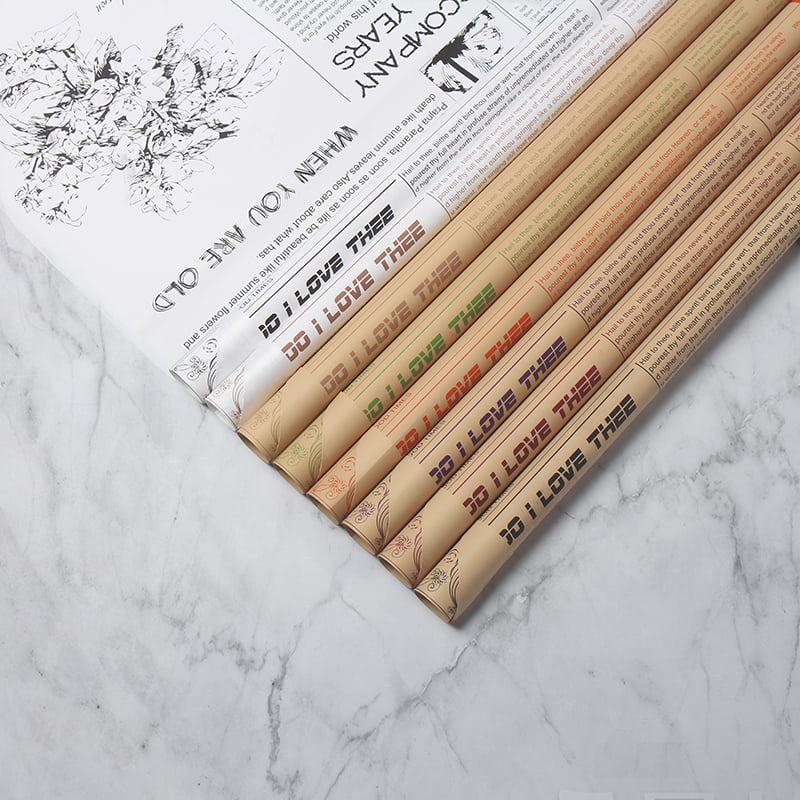 Retro Newspaper-Style Cowhide Flower Wrapping Paper in BOPP FilmA BOPP film wrap with retro newspaper-style cowhide print, sized 57 x 57 cm and packed 20 per bag for floral use.View Product →
Where film earns its cost
OPP and BOPP are the workhorses of the category. At 4.5 mil (roughly 0.114 mm) you get a crisp, transparent wrap that snaps when folded and holds a light cone. At 7.5 mil (about 0.19 mm) you get a heavier grade that keeps a large bouquet upright on a display table and survives being stacked in a delivery crate without creasing into white lines. Between those two numbers sits most of the practical range, and the jump from one to the other is more noticeable in handling than in price.
Cellophane, made from regenerated cellulose, is clearer and has more of a rustle, and it also responds to humidity by wrinkling, which is a real consideration in a cooler. Waterproof-coated and laminated papers sit between paper and film: they resist droplets and wipe clean, but they still behave like paper in the hand, which is why shops that want the look of paper with the durability of film tend to settle there.
The hybrid most shops settle on
The stack that survives both a photograph and a delivery is usually two layers of cotton or kraft inside and one layer of clear film outside, or the reverse. Film on the outside protects the paper and keeps the whole assembly rigid. Film on the inside, as a collar between the flowers and a kraft cone, frames the blooms without trapping condensation against the petals. The choice depends on how long the bouquet will sit sealed, which is the same question that decides every other part of this guide.
| Material family | Hand feel | Transparency | Water behaviour | Best-fit use |
|---|---|---|---|---|
| Cotton and tissue paper | Soft, matte, creases and stays creased | Opaque to semi-opaque | Absorbs splashes, cockles | Inner liners, relaxed hand-tied styles |
| Kraft paper | Dry, fibrous, holds a firm fold | Opaque | Wicks water, stains visibly | Rustic and natural outer wraps, everyday shop work |
| Matte laminated paper | Smooth, quiet, low sheen | Opaque or translucent | Wipes clean, resists droplets | Premium outer wraps, photographic work |
| Pearlescent film | Crisp with a soft lustre | Semi-opaque with light shift | Non-absorbent | Gift and occasion bouquets, colour-led designs |
| OPP and BOPP film | Crisp, snaps, springs back | High to full clarity | Fully non-absorbent | Protective outer layer, volume work, transport |
| Waterproof coated paper | Paper-like but smoother | Opaque | Beads and wipes, softens if soaked | Mixed paper-and-film looks, humid shops |
Reading a Spec Sheet: GSM, Mil, and the Numbers That Actually Matter
Most buyer complaints trace back to a unit conversion nobody did. GSM applies to paper and measures mass per square metre, which is a proxy for density and stiffness. Mil applies to film and measures thickness in thousandths of an inch; one mil is 0.0254 mm, so 4.5 mil is about 0.114 mm and 7.5 mil is about 0.19 mm. Micron is the metric equivalent, and 100 micron is 0.1 mm. When a supplier quotes "thick" without a number, you are being asked to trust a feeling.
| Number on the sheet | What it measures | Typical floristry range | Why the buyer should care |
|---|---|---|---|
| GSM | Paper mass per square metre | 25 to 60 gsm for liners; 80 to 120 gsm for kraft | Sets stiffness, opacity and how many sheets a bouquet needs |
| Mil | Film thickness in thousandths of an inch | 4.5 mil standard; 7.5 mil heavy grade | Governs fold memory, tear resistance and cone support |
| Micron | Thickness in thousandths of a millimetre | About 110 to 190 micron for bouquet film | The same property as mil, in metric; useful when comparing regions |
| Sheet size | Cut dimensions, usually in centimetres | 45 × 50 cm, 57 × 57 cm, 58 × 58 cm, 60 × 60 cm | Determines how many bouquets one pack yields |
| Roll format | Width × length on a core | Commonly 58 cm × 30 m on a 76 mm core | Reduces cutting labour but changes yield maths entirely |
| Tolerance | Permitted deviation from nominal | Often ±3 to 5 percent on GSM and thickness | Explains why two "identical" orders handle differently |
Tolerance is the number buyers forget to ask for and the one that causes the most friction on repeat orders. A ±5 percent allowance on a 4.5 mil film sounds trivial until you stack it against a ±3 percent allowance from a second supplier and discover that your folding technique, which was tuned to the heavier roll, now leaves creases that spring open. Ask for the tolerance in writing, ask whether it applies to the lot average or to every roll, and ask whether the supplier will hold a tolerance tighter than the standard one on request.
Then run three tests on arrival, none of which needs equipment. Fold a sheet into a hard crease and press it flat: paper should stay creased, film should spring back, and a film that stays creased is either too thin or has been stored somewhere hot. Drop water on the surface and leave it two minutes: beading means a coating or a non-absorbent base, absorption means you have a paper that needs a barrier layer under wet stems. Finally, hold the sheet against a shop light and then against a window: a colour that turns grey or green in daylight will photograph badly for customers using their phones, which in practice is most of them.
Waterproof, Anti-Fog, and the Cold-Chain Details
"Waterproof" is not a binary property, and treating it as one is how shops end up with water marks on an outer wrap they believed was protected. The useful question is what kind of water the material meets: a splash from a freshly cut stem, a damp cube of floral foam resting against the liner for six hours, or condensation forming inside a sealed cooler.
Coated paper resists droplets and wipes clean, but if it stands in contact with moisture for hours the base fibre still softens and the sheet loses its crispness at the collar. OPP and BOPP film are inherently non-absorbent, so the water sits on the surface until it evaporates or is wiped away. Double-sided coating on paper narrows the gap but does not close it entirely, and a buyer should expect a coated sheet to perform well for a shop day and poorly for a two-day transit.
Anti-fog treatment is the specification that separates a film built for coolers from a film built for display. Untreated film in a cold cabinet collects condensation as discrete droplets, which scatter light, blur the flowers behind them, and eventually drip onto petals. An anti-fog additive migrates to the film surface and lowers surface tension so the water spreads into a thin continuous sheet instead of beading. The effect is real but finite: it fades with age, it is reduced by abrasion and dust, and it does not survive being wiped with a dry cloth repeatedly. Buy anti-fog film in quantities you will use within a season rather than a year, and ask the supplier for the production date on the carton.
The scenario that catches most shops is the transition, not the storage. A bouquet moved from a 4 to 8 °C cooler into a warm, humid shop floor will fog within seconds no matter how good the film is, because the temperature difference is doing the work. In that situation the practical fix is airflow and a few minutes of acclimatisation, plus a film that spreads the condensate rather than releasing it as drops.
 Macaron Gradient Waterproof Flower Wrapping Paper in BOPP FilmWaterproof BOPP film in macaron gradient shades, cut 57 x 57 cm and packed 20 per bag for bouquet wrapping.View Product →
Print and Finish: Where Perceived Value Is Created and Lost
Two wraps can carry the same motif and land at completely different price points, because the finish does more work than the artwork. The levers are printing method, surface treatment, and edge treatment, and each one has a visible failure mode that a buyer can check in ten seconds.
Print quality in this category usually comes down to registration and ink laydown. Registration is the alignment between colour plates; a tolerance of one to two millimetres is normal, but on a 57 cm sheet that tolerance determines whether a floral motif can be centred. Ask for a cut sample rather than a flat sheet, because a design that looks balanced on an uncut sheet can lose half a rose when the shop trims it to fit a cone. Ink laydown matters on dark colours: a heavy black or deep green printed thinly will look streaky under shop lighting, and no amount of styling hides it.
Surface treatments change how light behaves on the wrap, which is why they read as value. Aluminum plating gives a metallic, mirror-like face and a strong colour shift as the bouquet moves. Pearlescent film uses a pearl pigment dispersed in the film itself, so the lustre is in the material rather than on top of it and does not scuff off. Matte lamination kills reflection and makes a photograph look calmer, which is why it dominates the premium segment even though it costs more per square metre than a plain gloss. Embossing and relief printing add a tactile dimension that customers notice when they pick the bouquet up, and that is often what they describe when they say a wrap feels expensive.
Edge treatment is the cheapest lever with the highest perceived return. A gold or silver edge is applied along the trimmed border, so the quality of the cut decides the quality of the edge: a dull blade leaves a ragged line and flaking foil, while a clean trim gives a crisp band that catches light along the whole cone. Product codes often carry a figure such as "2 cm," which typically refers to the width of that edge band or trim margin rather than a reduction in sheet size, so confirm which it means before you calculate yield.
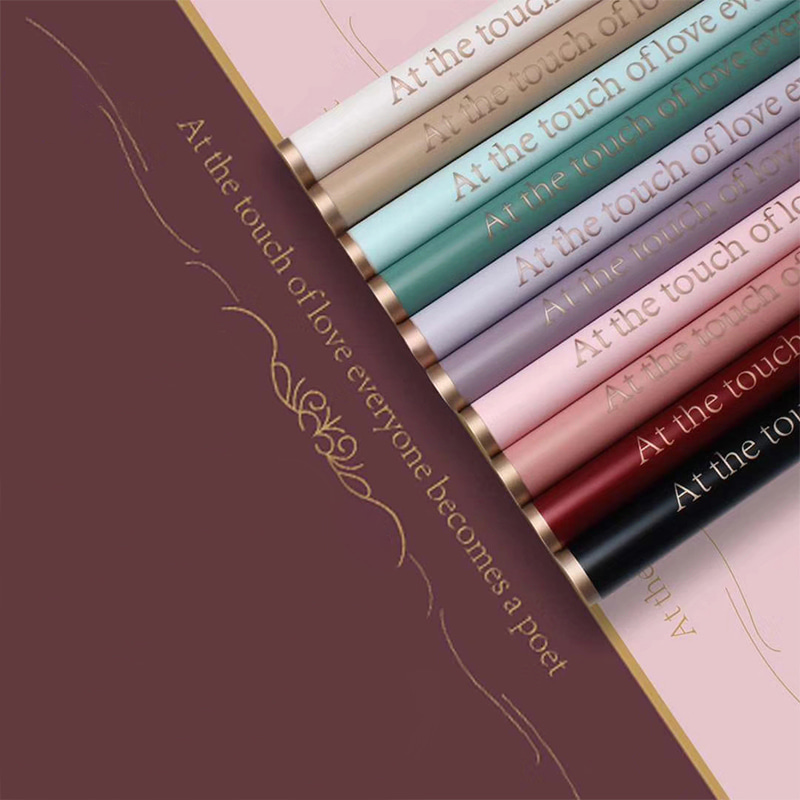 9-Color Gold-Edged Matte Flower Wrapping PaperMatte floral wrapping sheets with gold edging across nine colors, sized 58 x 58 cm and packed 20 sheets per pack.View Product →
Size, Format, and the Yield Arithmetic Every Buyer Should Run
Price per pack is the least useful number in this category. Price per finished bouquet is the only one that compares fairly across formats, and the arithmetic takes about a minute once you know your own consumption.
Sized sheets in this trade cluster around 45 × 50 cm, 57 × 57 cm, 58 × 58 cm and 60 × 60 cm. A standard shop bouquet built on a hand-tied frame typically consumes three to five outer sheets, or two outer sheets plus one or two liners if the design is layered. Divide the pack count by that number and you have bouquets per pack. A 20-sheet pack at four sheets per bouquet yields five bouquets; the same design at three sheets yields closer to six and a half, which is a 30 percent swing in material cost from a change nobody recorded.
Rolls work differently and are often cheaper per bouquet in high-volume shops. A 58 cm × 30 m roll gives 30 linear metres of usable film. If a bouquet takes 1.2 to 1.8 m of film when wrapped around a cone with an overlap, one roll covers roughly 17 to 25 bouquets, minus the tail end that is too short to use. Roll wrapping also removes the cutting error that eats into sheet yield, but it adds a new one: staff pulling an extra half metre because the roll runs out mid-wrap. Track roll consumption per week against bouquet count for a month and the true figure emerges quickly.
The format decision usually comes down to labour. Sheets suit low-volume, design-led work where the wrap is cut to the bouquet. Rolls suit repetitive volume where speed matters more than silhouette variety. Shops that do both often keep rolls in two or three neutral workhorses and sheets in the patterned designs, which keeps the patterned stock from ageing on the shelf while the everyday wrap keeps moving.
Colour Matching Across Batches and Under Different Lights
The most expensive wrapping mistake is a colour that matched once. Every material in this category can shift between production batches, and the shift is nearly invisible on a screen. Buyers who manage it well do three things: they keep a physical master swatch, they specify a tolerance, and they check under the light the customer will actually see.
On the tolerance question, colour difference is usually expressed as a Delta E value calculated from measured colour coordinates, and a Delta E under about 1.5 to 2 is generally treated as visually indistinguishable in adjacent pieces. Not every supplier will quote a Delta E, but asking the question changes the conversation, because it signals that a repeat order with a visible shade break is a defect rather than a preference. Pearlescent and aluminum-plated materials need extra care here, since the pearl or metallic layer creates a directional colour shift that depends on viewing angle and pigment orientation. Two rolls from the same production run can look different when one is unrolled in the opposite direction.
Lighting decides the rest. A warm 3000 K shop lamp flatters peach and gold and dulls blues. Daylight at roughly 5500 K is closer to how a phone camera records the bouquet, which is how most customers will see it. A gradient or two-tone film that reads beautifully under shop lighting can turn muddy in a photograph taken near a window, and the customer blames the flowers rather than the lighting. Keeping a dated master swatch in a dark drawer and replacing it every six to twelve months is a small discipline that prevents a large argument.
One more trap: the same colour name does not mean the same colour across material families. A "dusty rose" matte paper, a dusty rose pearl film and a dusty rose cotton liner are three separate colour developments, and mixing them in one bouquet is a coin toss unless you have seen them together.
Ribbon, Mesh, Bags, and Foam: The Small Items That Decide the Finish
Accessories are where a well-specified bouquet is quietly finished or quietly ruined. They are also where buyers most often substitute on price, because the unit cost is small and the failure is not immediately obvious on an invoice.
Ribbon choice interacts directly with the wrap surface. Satin slides on glossy film and needs a double knot or a pin to hold; grosgrain and cotton ribbon grip better and suit kraft and matte finishes. Width should follow bouquet scale: roughly 1 cm for small posies, 2 cm for standard hand-tied work, and 5 cm or wider for large event pieces where the ribbon is part of the composition. A ribbon that curls well is a different product from one that holds a flat bow, and the two are not interchangeable in a shop that does both.
Mesh adds volume without weight and is the standard way to build a wide, airy collar around a small bouquet. It snags on dry hands and on the cut edges of kraft paper, so a shop using both should store them apart. Packaging bags for single stems and small gifts need to be sized to the stem length in use rather than to a generic standard, because a bag that crimps the bloom damages more stock than it protects. Floral foam is the one accessory that behaves like an engineering component: wet foam absorbs and holds, dry foam is for artificial work only, and using the wrong one produces a bouquet that wilts on the counter within a day.
The full accessory set, from ribbon through mesh to bags and foam, is worth assembling from one source where possible, because mixed sourcing on small items multiplies delivery costs and makes consistent colour across a design programme much harder to hold.
A wider range of finishing options is listed under floral ribbon and finishing supplies, which is a sensible place to check widths and weaves against your current stock before committing to a season's quantities.
Sustainability Questions Worth Asking Before You Sign
Recyclability in this category depends on structure, not on intent. A sheet of uncoated kraft or tissue is a single material and generally fits paper recycling streams. A paper laminated to a polyethylene layer, or a paper with a waterproof coating, is a composite, and composites are where municipal recycling systems usually stop. That distinction matters more than any label on the packaging.
Four questions cut through most of the ambiguity. Is the product a single material or a composite, and if composite, can the layers be separated? Does the recycled-content or recyclability claim apply to the base material, the coating, or the manufacturing process? Is there documentation, or is the claim a marketing statement? And what happens to the material in the specific market you sell into, since collection rules differ by city and by country?
Supplier self-descriptions deserve to be read as exactly that. A manufacturer describing its output as environmentally friendly is making a positioning statement, and a buyer's job is to ask for the layer structure and any supporting documentation rather than accepting the adjective. Where a shop wants a defensible claim, uncoated paper and simple film with a clear end-of-life route are the easiest positions to hold, and mixing them in one bouquet is usually fine because the customer separates paper from film without thinking about it.
Supplier Vetting, MOQ, and the Sample Process That Saves Money
Samples are only useful if they come from the production run you are about to buy, not from a showroom drawer. The first request to any new supplier should be a sample cut from current stock, with the production date and the batch reference, in the exact colour and thickness you intend to order. A showroom sample can be two years old and from a discontinued run, which makes it a beautiful, useless piece of evidence.
Then test it the way your shop will use it. Wrap three bouquets with it, leave one in the cooler overnight, put one in a delivery crate, and keep one on the counter for a week. Check how it creases, whether the print survives handling, and whether the colour still matches the master swatch after a week under shop light.
On commercial terms, the questions that prevent most disputes are these:
- Minimum order quantity per SKU, per colour, and per design, since these are often three different numbers.
- Whether mixed designs are allowed within one order and how that affects the price tier.
- Carton configuration: sheets per pack, packs per carton, and the carton dimensions, because storage space is a real cost in a small shop.
- Lead time for stock items versus printed items, stated separately.
- Tolerance on thickness, GSM, sheet size and roll width, in writing.
- How shade variation between repeat orders is handled, and whether the supplier will hold a reference swatch on file.
- Defect policy: what counts as a defect, what evidence is required, and whether credit or replacement applies.
For a first order, buying two or three designs deeply rather than ten designs thinly is almost always the better decision. It lets you measure sell-through per design with a meaningful sample and it avoids the familiar outcome of a dozen opened packs and no clear bestseller.
Building a Wrap Programme: Core, Seasonal, and Experimental
A wrap programme is a stock plan, not a shopping list, and the shops that keep material costs predictable tend to split their range into three tiers. Roughly seventy percent of stock sits in the core: clear film at one working thickness, a matte neutral in black or white, a kraft, and a cotton or tissue liner in white and ivory. These are the materials that must never run out and should be reordered on a schedule rather than on discovery.
Around twenty percent is seasonal, two or three prints per season, bought in quantities sized to the season and not to the year. A printed design has a shelf life in customer perception even if the material itself keeps perfectly, and leftover stock from a season is the most common form of dead inventory in this trade.
The remaining ten percent is experimental, one or two pieces bought small to test a finish or a colour direction. That is where a gold edge, an aluminum-plated face, or a gradient print earns its place or does not. Measuring sell-through by counting sheets consumed per design per month gives a far better signal than how the samples looked on the bench, and it is the only reliable way to decide which experimental piece gets promoted into the core next year.
A Practical Checklist Before Your Next Order
Run through this list before confirming a purchase order, and most of the failures described above disappear before the carton arrives.
- Confirm the layer stack for each bouquet style: outer wrap, liner, barrier, finishing hardware.
- Match thickness and GSM to the journey time, not to the photograph.
- Get tolerance figures in writing for GSM, mil, sheet size and roll width.
- Request production-run samples with batch reference and production date.
- Test a sample by folding, splashing and holding it against daylight.
- Confirm whether "2 cm" in a product code means an edge band or a size reduction.
- Calculate cost per bouquet, not cost per pack, for every format you stock.
- Keep a dated physical master swatch and replace it every six to twelve months.
- Check ribbon and mesh compatibility with the wrap surface before a large order.
- Buy seasonal prints in season-sized quantities only.
The order of decisions is what makes the process reliable. Start with where the bouquet goes, because transport decides whether the outer layer needs to be film. Then build the stack underneath it, so the liner is chosen to flatter the outer wrap rather than to look good on its own. Then confirm the numbers that support that choice: thickness in mil or micron, GSM for paper, tolerance for repeat orders, and the edge and print details that carry perceived value. Only after those three steps does price per pack become a meaningful comparison.
Most of the difference between a wrap that photographs well and one that survives a delivery is not artistic. It is a small set of decisions about thickness, coating, cut quality and colour control, made before anything is folded. Buyers who get those right find that the design side becomes much easier, because the material stops fighting the hands that use it.
 +86-18270363850

