 English
 русский
 عربى



add: North of Gaoxin North Road, east of Jinyun Road, Wannian High-tech Zone, Shangrao City, Jiangxi Province
A florist packing forty red rose bouquets for a Saturday wedding has roughly nine minutes per bouquet. The wrap that behaved perfectly in a dry shop starts beading water the moment the bouquets go into the cooler. By the time the van arrives, the kraft outer sheet has softened along its fold line, the base has sagged, and the bouquet leans into the customer's arm at an angle nobody planned for. That delivery cost real money in stems, ribbon and driving time, and it was lost to a sheet of paper that was chosen for its colour.
The short answer is that wrapping paper for roses is a moisture, weight and abrasion decision before it is a decorative one. Choose a sheet that is coated or filmed on the side facing the stems, heavy enough that a thorn will not run, and wide enough that the weight of the bunch sits on a folded seam instead of a single pinch point. Style comes after those three conditions are satisfied. A plain matte sheet with a clean fold will always look more expensive than a glossy print that has cockled.
What follows covers the wrap families that genuinely work for roses, the sheet sizes and thicknesses that match real bouquet weights, the condensation problem that catches out new florists every winter, and the arithmetic that decides whether a bulk order saves money or quietly costs it.
Roses Make Four Demands That Most Wraps Were Never Built For
Roses are not tricky to wrap because they are delicate. They are tricky because they are heavy, thirsty, thorny, and usually sold at a price point that makes every wrinkle visible to the customer standing at the counter.
- Water on both sides of the sheet. Stems arrive wet from the bucket and stay wet inside the wrap. On an uncoated sheet, that moisture wicks outward from the inside while condensation attacks from the outside. Once a plain paper sheet has taken water at a fold, it will not flatten again, and no amount of smoothing will hide it.
- Thorns and trimmed stem ends. A thorn will push through a thin film without any real effort, and a puncture becomes a running tear the first time someone lifts the bouquet by the wrap instead of the base. Anything under roughly 4.5 mil, or about 0.11 mm, should be treated as a decorative layer rather than a structural one.
- Load concentrated at the gather point. A dozen long-stemmed roses with a soaked foam base and a heavy ribbon can approach 1.5 kg. All of that mass passes through the two or three square centimetres where the sheet is gathered and tied. Sheets folded once at the gather point hold up; sheets crushed into a single pinch fail on the second or third delivery.
- Repeated temperature swings. Roses move from a 4 to 8 degrees Celsius cooler into a 20 to 24 degrees Celsius shop, then into a warm car. Every transition lays down condensation. A wrap that cannot shed that water will pass it inward to the petals, and petal damage is the only part of the job the customer always notices.
Each of those four demands fails in its own visual way. Water damage shows as cockling and tide marks. Thorn damage shows as a puncture that has propagated into a tear. Load damage shows as a collapsed base and a bouquet that leans. Condensation shows as spotting on the petals or water rings on the film. Being able to name the failure is faster than changing sheets every week and hoping.
Four Wrap Families That Suit Roses, and What Each One Costs You
Almost everything sold as rose wrapping falls into a handful of material groups. What separates them in daily use is not the print but the coating, the thickness, and how the sheet behaves when it is folded and gathered.
| Wrap family | Typical build | Where it fits | Main risk to watch | Relative cost |
|---|---|---|---|---|
| Coated waterproof film | BOPP or OPP, 4.5 to 7.5 mil, single or double sided coating | Outer layer for retail, transport, cooler display | Edges curl if stored rolled too tightly; ink can scuff on cheap grades | Medium |
| Matte and pearlescent film | Matte BOPP with gold or silver edge, embossing or hot stamping | Gift bouquets, weddings, premium retail | Matte surfaces hold fingerprints and grease | Medium to high |
| Cotton and ouya paper | 17 to 22 gsm, often single sided print, aluminium plated variants available | Inner layer behind or beneath a film outer | Not waterproof on its own; softens against wet stems | Low to medium |
| Kraft and newspaper style | 40 to 80 gsm, uncoated or lightly coated, printed or plain | Rustic, sympathy, farm style and market bunches | Loses tear strength quickly when damp; creases sharply | Low |
| Transparent crystal film | High clarity OPP or cellophane, 4 to 5 mil typical | Showcase wrapping where the flower is the design | Reveals every leaf flaw and every drop of water | Low |
| Mesh and non woven net | Soft net, 30 to 50 cm rolls | Volume, layering, contrast texture | Catches on thorns and pulls threads | Low |
The combination most working shops settle on is a soft cotton or ouya inner layer for contrast and a coated film outer for protection. The cotton gives the bouquet a warm, hand finished collar near the petals; the film takes the water, the thorns and the handling. Wrapping roses in a single layer of uncoated paper and calling it done works only for bouquets that will be handed over within the hour.
For the premium end of the market, matte and pearlescent films with a gold or silver edge are the practical upgrade. They photograph well under shop lighting, they hide minor creases better than gloss, and the edge band gives a clean, deliberate border without needing a second sheet. The trade off is that matte surfaces show every fingerprint, so they suit shops where bouquets are assembled with gloves or finished with a final wipe.
Sheet Size, Thickness and Roll Width: The Numbers Behind Most Reorders
Why 57 by 57 cm dominates the supply chain
Walk through any flower market and you will see the same sizes repeated: 57 by 57 cm for printed film and cotton, 58 by 58 cm for cellophane and clear film, and 45 by 50 cm for smaller hand tied work. Those are not arbitrary numbers. A 57 cm square gives a diagonal of roughly 80 cm, which is enough to wrap a rose bunch with a finished circumference of about 35 to 45 cm and still leave 8 to 12 cm of overhang at the top edge for the collar.
The working rule is simple. The diagonal of the sheet should be at least twice the distance around the widest part of the finished bouquet, plus about 10 cm for the fold and the tie. A dozen long stemmed roses with their heads spread will often exceed 45 cm around the outside of the wrap, which puts a 45 by 50 cm sheet right at its limit and a 57 cm square comfortably inside it. If you are constantly running short at the top, the sheet is too small, not the technique.
Mil, micron and gsm are not interchangeable
Film thickness is quoted in mil, meaning thousandths of an inch, or in micron. One mil is about 25.4 micron, so a 4.5 mil film is roughly 114 micron and a 7.5 mil film is roughly 190 micron. Paper is quoted in gsm, or grams per square metre. Cotton and ouya papers used for flower work commonly sit between 17 and 22 gsm, tissue between 14 and 17 gsm, and kraft between 40 and 80 gsm.
The practical consequence is that a supplier saying "thick film" tells you nothing. A 2 mil film described as thick is still thinner than a standard 4.5 mil sheet, and a 22 gsm cotton is not automatically stronger than a 17 gsm one if the fibre and the coating differ. Always ask for the unit and the number. It is the single fastest way to compare two quotes that look identical on paper.
Sheets or rolls
Pre-cut sheets win on speed at the packing bench and lose on waste when bouquet sizes vary. Rolls win on flexibility and cost per metre, and lose on the extra seconds per bouquet and the discipline required to cut consistently. Shops that produce more than about eighty bouquets a week usually end up running rolls for their house wrap and pre-cut sheets for anything premium or printed. Wholesalers who supply other florists generally prefer pre-cut, because their customers are buying speed as much as material.
Waterproof and Anti Fog Are Two Different Products
Waterproof means water does not pass through the sheet. Anti fog means water vapour does not condense into visible droplets on the surface. A film can be completely waterproof and still turn a display cooler into a fogged glass box where nobody can see the flowers.
Here is why it matters for roses specifically. A cold rose bouquet is releasing moisture constantly. Every time the cooler door opens, warmer air meets the cold film, and the vapour condenses. On a clear film, droplets scatter light and blur the bouquet behind them, and once they grow heavy enough they run down and drip onto the petals. On a matte film, the droplets dry into water rings that look like a manufacturing defect to the customer.
Anti fog treated film changes the surface tension so condensation spreads as a thin, transparent layer instead of forming beads. It does not stop condensation from happening, and it will not rescue a bouquet that is sealed inside a plastic sleeve while soaking wet. What it does is keep the wrap readable and keep droplets off the petals during the first and most visible hours of display.
 OPP Anti-Fog Treated Flower Packaging FilmWholesale OPP flower wrap with anti-fog treatment, useful for keeping condensation readable during display and worth checking with the hot-water test on arrival.View Product →
A quick test with a sample is worth more than any specification sheet. Hold the film over a cup of hot water for about a minute, then look at it from a low angle. A treated film stays largely clear; an untreated film develops a scatter of visible beads. Run that test on arrival, before the ream goes on the shelf, and you will catch substitutions early.
Where waterproofing matters most is transport in humid weather, bouquets that sit in buckets before wrapping, and any bouquet that goes straight from the shop into a refrigerated van. Where it matters least is a dry, air conditioned retail floor with a two hour turnover, which is why many shops keep both a waterproof outer and a cheaper uncoated inner rather than paying waterproof prices for a layer nobody sees.
Matching the Wrap to Rose Colour and to the Occasion
Red roses
Red is the hardest colour to wrap well because everything competes with it. Deep reds look richest against matte black, charcoal, deep green or a clean white with a silver edge. Avoid warm mid tone prints and busy florals behind red roses; the flower loses its outline and the bouquet reads as a blur from two metres away. A plain matte sheet with a single gold or silver edge band gives contrast without noise.
White, cream and pastel roses
Pale roses reward softness. Cotton and ouya papers in off white, dove grey, sage or blush give a matte, slightly fibrous surface that photographs beautifully and feels expensive in the hand. This is also where subtle print earns its place: fine line drawings, single colour dots, delicate lettering. Keep the print small, because a large motif overwhelms a pale bloom that has no strong colour of its own to hold the eye.
Yellow, orange and novelty colours
Bright roses tolerate stronger pattern and higher contrast. Striped, checkered and two tone film in complementary colours works here, as does a translucent sheet that lets the colour glow through. This is the category where a printed rose motif on the wrap itself can work, provided the pattern is scaled small enough that it reads as texture rather than as a picture of flowers next to actual flowers.
 Rose Pattern Waterproof Flower Wrapping PaperThickened waterproof floral wrap in 58 x 58 cm sheets, 20 per pack, with a rose pattern and color choices for bright-rose bouquets needing texture.View Product →
Occasion logic
The occasion decides the material more than the colour does. Valentine's Day and Mother's Day move enormous volume in a short window, so speed and consistency beat novelty; pre-cut waterproof sheets with a reliable print are the practical choice. Weddings and proposals justify matte, pearlescent or edge banded film, where the wrap will be photographed closely and handled by people who are nervous. Sympathy work generally calls for restraint: kraft, soft grey, plain white, no glitter and no high contrast pattern. Corporate and hotel accounts want something that looks the same in March and in October, which usually means a solid colour film in a fixed specification held in stock rather than a seasonal print.
If you want a wider view of how wrap choices shift across occasions, there is a useful breakdown in our guide to choosing the right flower wrapping paper for each occasion.
Where Transparent Film Earns Its Place
Clear film is the most misunderstood material in the shop. Used badly, it makes a bouquet look like supermarket stock. Used well, it is the fastest way to prove that the flowers are fresh and that the arrangement inside is deliberate.
Transparent crystal film, high clarity OPP and jelly films work on one condition: the bouquet underneath has to be clean. Every bruised petal, every browned leaf tip and every drop of water sitting in the fold will be visible. That sounds like a disadvantage, and in a shop with inconsistent prep it is. In a shop that grades and cleans its stems properly, a clear wrap with a cotton collar and a ribbon does more selling than any printed sheet, because the customer can see exactly what they are paying for.
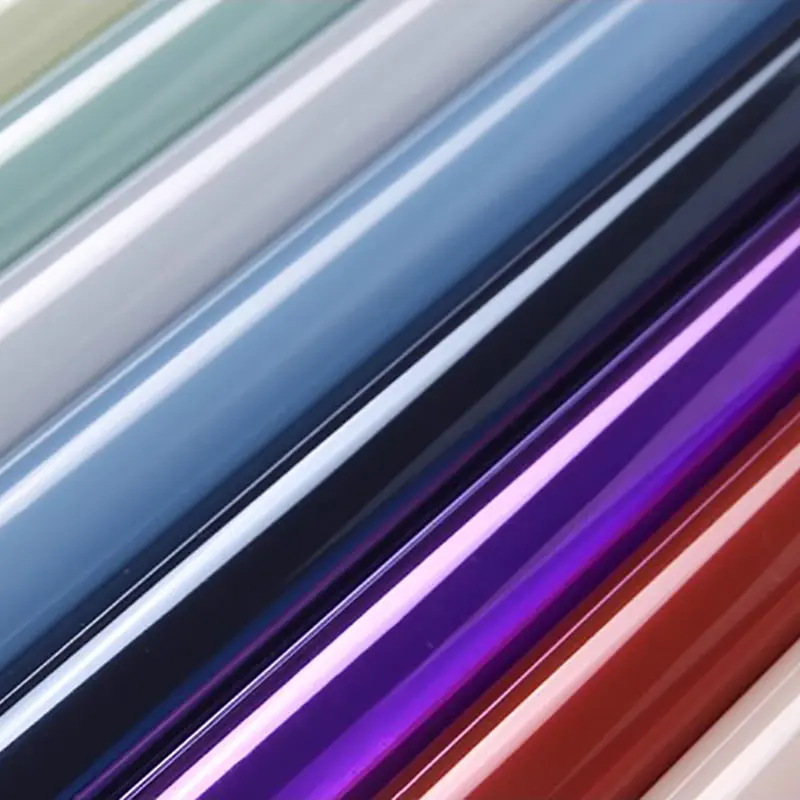 Waterproof Transparent Crystal Glass Flower Wrapping PaperCellophane floral wrap in 60 x 60 cm sheets, 20 per bag and 22 colors, suited to clean bouquets where visible petals sell the arrangement.View Product →
The practical combination for retail is clear film on the outside with a soft coloured cotton or tissue layer behind it, offset so that about a third of the bouquet stays visible. That gives you colour, depth and transparency at the same time, and it hides the mechanics at the base without hiding the flowers. For wholesale and market work, a single layer of clear film is usually enough, because the buyer is judging the stems, not the styling.
How Many Sheets a Bouquet Really Takes
Most rose bouquets consume between three and five sheets, split between an inner collar and an outer wrap. Under-ordering per bouquet is one of the most common causes of a wrap that looks thin and cheap; the fix is rarely a more expensive paper, it is one more sheet.
| Bouquet type | Stems | Inner sheets | Outer sheets | Total |
|---|---|---|---|---|
| Posy or gift box filler | 5 to 7 | 1 | 1 to 2 | 2 to 3 |
| Hand tied bunch | 10 to 12 | 1 to 2 | 2 | 3 to 4 |
| Classic dozen, long stem | 12 | 2 | 2 to 3 | 4 to 5 |
| Presentation or event piece | 24 plus | 2 to 3 | 3 to 4 | 5 to 7 |
| Market or wholesale bunch | 20 plus | 0 to 1 | 1 to 2 | 1 to 3 |
Take a shop doing 120 bouquets a week at an average of five sheets. That is 600 sheets, or six reams of 100. Add a realistic 10 percent for trimming, mistakes and the sheet that gets creased and abandoned, and the order becomes seven reams a week, roughly 28 a month. Shops that order on gut feel tend to buy in bursts, run out midweek before a holiday, and end up paying express freight that costs more than the paper.
Two habits remove most of that risk. First, track actual consumption for four weeks rather than estimating it; the real number is almost always higher than the guess. Second, keep a fixed buffer sized to your busiest week of the quarter, not your average week, because wrap shortages never happen on a quiet Tuesday.
Cost per Bouquet Beats Cost per Sheet Every Time
Comparing wrap on price per sheet is the most common buying error in the flower trade, because the sheet price is the smallest part of the real cost. Labour, rewraps and waste dominate.
Consider two sheets. Sheet A costs 0.05 per unit and takes six sheets and about eight minutes to wrap a dozen roses well. Sheet B costs 0.09 per unit and takes four sheets and about six and a half minutes, because it folds cleanly, holds a crease and does not need a second attempt. On materials alone, A wins: 0.30 against 0.36. Add labour at a modest 15 per hour and the picture inverts. The 90 seconds saved is worth about 0.38, so B is ahead by roughly 0.31 per bouquet, before counting the bouquets that A forces you to rewrap because the fold tore.
At 120 bouquets a week, that difference is around 37 per week and roughly 1,900 a year from one product change. The numbers above are illustrative, but the structure holds in almost every shop: cheap wrap that is slow to fold, tears at the gather point or needs an extra layer is rarely cheap once labour is counted.
There is a second, quieter cost. Wrap that behaves inconsistently makes staff slow down and second guess, which shows up as a queue at the counter on the busiest day of the year. Consistency of fold, edge and thickness across reams is worth paying for, and it is the first thing to verify when a cheaper supplier appears with an attractive quote.
Paper, Film or Both? A Straight Answer on Sustainability
Uncoated paper has the cleaner end of life story in most municipal systems, and it is the right choice wherever the wrap will stay dry: inner collars, dry retail floors, hand delivery. Coated film keeps roses intact through transport and cold storage that paper cannot survive, and its problem is collection rather than performance. Neither material is universally better; the answer depends on where the sheet spends its first six hours.
The practical position for a rose shop is to use paper where it will remain dry and film where it will meet water, rather than layering both everywhere for the look of it. Double wrapping for visual bulk is the most common source of avoidable waste in bouquet work, and it also makes the bouquet heavier and harder to carry. A single well chosen sheet, folded properly, generally looks better than two mediocre ones.
If you are weighing the two routes in more detail, including how each behaves in cold chain and what customers actually ask at the counter, our comparison of plastic versus paper flower wrapping covers the trade offs without the marketing language.
A Bulk Order Checklist for Rose Wrapping Paper
Before a large order goes in, run through these points. Each one has caught out a shop at least once.
- Confirm the unit and the number. Micron for film, gsm for paper. "Thick" and "premium" are not specifications.
- Confirm the sheet count per pack. A ream of 100 and a pack of 80 look identical on a pallet and change your cost per bouquet by a fifth.
- Ask for the coating side. Single sided coated film must face the stems; if the pack does not say which side is which, staff will get it wrong half the time.
- Test the fold. Fold a sample sheet in half and press the crease. A good film holds a line; a poor one springs open or turns white along the fold.
- Test the thorn. Push a trimmed stem end through a sample. If it passes through with no resistance, that sheet is a decorative layer only.
- Test the water. Put a few drops on the coated face and leave it ten minutes. Any darkening on the reverse means the coating is incomplete.
- Run the fog test if the wrap will be used in a cooler or a refrigerated van.
- Check colour consistency across lots. Ask for a sample from the current production run, not from a showroom set, and compare it with your last order under shop lighting.
- Confirm minimum order, lead time and holiday cut offs. Ask specifically what happens to lead times in the six weeks before Valentine's Day, and get the answer in writing.
- Ask about mixed pallets. Ordering three or four designs in one shipment is often cheaper than three separate orders, and it gives you a fallback if one print sells faster than expected.
Samples are the cheapest part of any bulk order and the most valuable. A supplier who will not send a sample pack of the actual production run is telling you something useful about how the relationship will go.
Storage and Handling That Protect the Sheet
Wrap fails on the shelf as often as it fails at the bench. Film and paper both pick up moisture from the air, and a ream stored on a concrete floor in a humid back room will develop wavy edges that make clean folding impossible.
Keep stock off the floor, ideally on shelving at least 15 cm up, in a space held around 40 to 60 percent relative humidity. Store reams flat rather than leaning, because film that has been stored on edge takes a permanent curl that shows up every time you wrap. Keep stock out of direct sunlight, since UV fades printed colours unevenly and can make clear film yellow. Rotate stock so the oldest ream is used first, and keep the original outer film on opened reams between uses rather than leaving sheets exposed to dust and shop humidity.
At the bench, keep one sheet under the bouquet and keep scissors away from the stack. Most waste in a busy shop is not theft or damage, it is sheets creased by being dragged across a scored worktop because the stack was left in the wrong place. A shallow tray or a simple divider costs almost nothing and saves a measurable amount of wrap every week.
The Three Mistakes That Cost the Most
Buying on colour alone
A beautiful print on an uncoated 17 gsm sheet is a display item, not a working wrap for roses. Buy the material for the conditions first, then choose the print from the materials that survived that filter. This one change prevents most of the complaints that start with "the paper went soft".
Mixing lots mid-season
Two production runs of the same colour are never identical, and a customer who orders the same bouquet twice will notice a shade difference long before they notice a price difference. For any account that reorders, hold one lot for the contract, or confirm that your supplier can hold a shade for the season.
Over-wrapping to compensate for a weak sheet
Adding a third and fourth layer to fix a sheet that tears or cockles increases cost, weight and waste, and it usually looks worse than a single layer of the right material. If a bouquet needs four sheets to hold its shape, the sheet is wrong, not the bouquet.
Rose wrap is a small line item that decides a large share of how a bouquet looks when it changes hands. Get the moisture handling right, size the sheet against the actual finished bouquet rather than the stem count, choose thickness by the unit rather than the adjective, and count cost per bouquet instead of cost per sheet. Those four decisions cover most of what goes wrong, and none of them require a bigger budget, only a more deliberate order.
For shops, the simplest starting point is a two part system: a soft cotton or ouya inner for contrast and a coated film outer for protection, both in a size that gives at least 10 cm of overhang at the collar. Add a clear film and an anti fog option if you run a cooler, and a matte or edge banded sheet if you sell gift work. That is a stock list small enough to manage and wide enough to cover nearly every rose bouquet that comes through the door.
 +86-18270363850

