 English
 русский
 عربى



add: North of Gaoxin North Road, east of Jinyun Road, Wannian High-tech Zone, Shangrao City, Jiangxi Province
What Pearlescent Flower Wrapping Paper Really Changes
A florist choosing pearlescent flower wrapping paper is not simply choosing a color. They are choosing how a bouquet will read under shop lighting, in a delivery van, and in a customer's phone photo. The practical conclusion is this: pearlescent paper works best when it is treated as a controlled lighting tool, not as decoration added at the last minute. A soft pearl surface can lift pale roses, add depth behind ranunculus, and make a simple hand-tied bouquet look more finished. A heavy or poorly coated pearl surface can do the opposite: it can make white blooms look gray, exaggerate creases, and create glare that hides the flowers.
The effect comes from the way the surface scatters light. Pearl pigments and coated films reflect light at slightly different angles, so the wrap changes as the bouquet is turned. That is useful in a retail cooler, where customers see the bouquet from several positions. It is also useful in photography, because the paper can separate the bouquet from a plain background without requiring a strong color contrast. The risk is that pearl finishes are less forgiving than matte paper. Fingerprints, sharp folds, wet stem ends, and uneven cutting all show more clearly. For daily florist work, a clean pearl film in a standard sheet size is usually safer than a highly embossed or heavily gold-edged design unless the order is for an event.
For a reliable counter style, a solid pearlescent sheet with a defined edge gives structure without competing with the flowers. The gold-edge solid pearlescent film is a practical example of that balance: the pearl surface adds sheen, while the edge provides a deliberate finish line for layered wrapping.
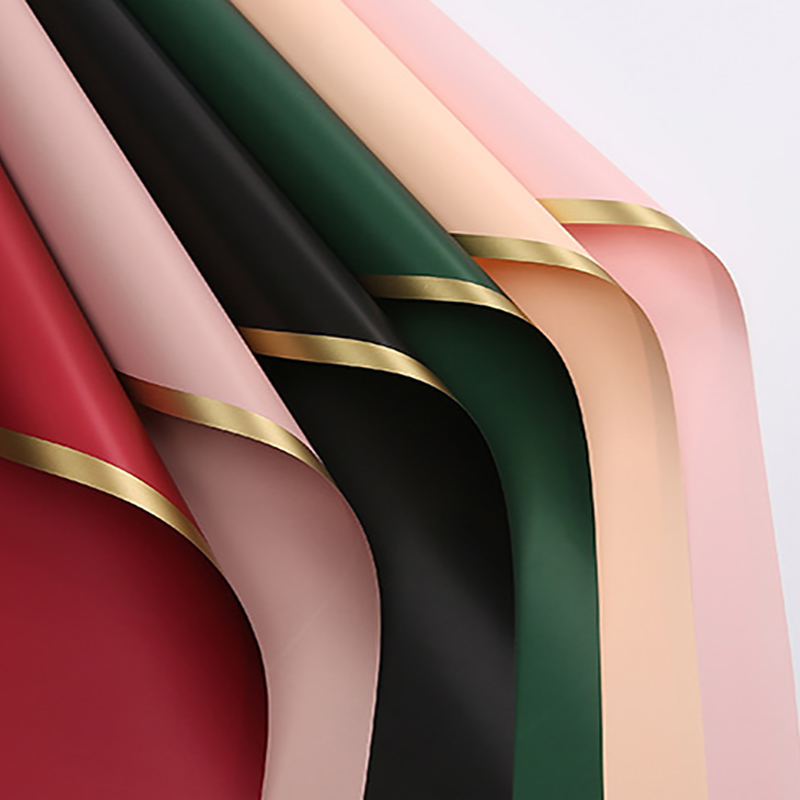 Gold-Edge Solid Pearlescent Flower Wrapping FilmA solid pearlescent BOPP film with gold edging, offering a defined finish for layered bouquet wrapping at the counter.View Product →
Start With the Job the Wrap Must Do
Before comparing brands, finishes, or price per sheet, define the job. Pearlescent wrapping paper is rarely the only protective layer in a professional bouquet. It is usually the visible outer or middle layer, while a waterproof film, tissue, or absorbent pad handles moisture and abrasion. If the bouquet is for local hand delivery, the pearl layer can sit close to the flowers. If it is moving through a wholesale market or spending hours in a cooler, the pearl layer needs a compatible base film and a clean separation from wet stems.
- Retail counter bouquets: choose a medium pearl sheen that photographs cleanly and does not overpower flower color. Solid colors and small prints are easier to repeat across daily orders.
- Wedding and event work: a stronger pearl, gold edge, or embossed pattern can add ceremony, but order extra sheets because creases and handling waste increase during installation.
- Wholesale and transport: prioritize surface durability, consistent sheet size, and resistance to scuffing. A decorative pearl layer should not replace a waterproof or anti-fog outer film.
- Cold-chain display: check for explicit waterproof or moisture-resistant wording. Condensation can dull a pearl surface and soften some paper-based coatings.
Printed pearl designs are useful when the bouquet needs a theme without adding ribbon or tags. A vintage camellia pattern, for example, can carry a seasonal or romantic message while the pearl base keeps the wrap from looking flat. The important buying question is whether the print sits cleanly on the pearl layer or breaks up when the paper is folded.
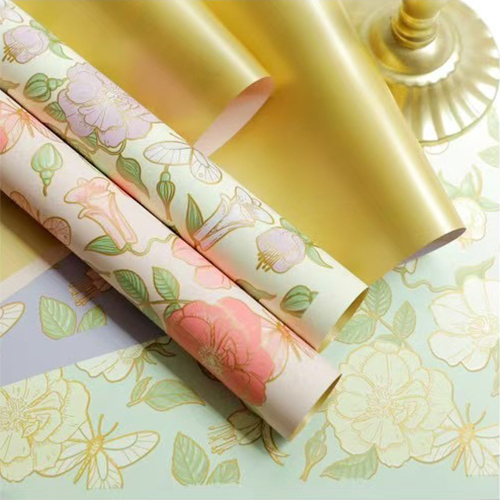 Gold-Edged Vintage Camellia Pearlescent Flower Wrapping FilmA pearlescent BOPP bouquet wrap with a vintage camellia pattern and gold edging, suited to themed floral presentations.View Product →
How to Read Pearlescent Wrapping Specifications
Specifications matter because two rolls can look similar on a screen and behave very differently on a workbench. The base material, coating, thickness, sheet size, and edge treatment all affect how the wrap folds, reflects light, and survives delivery. Thickness in mil is not the same as paper weight in gsm, and a higher number is not automatically better. A 4.5 mil film may be easier to fold for small bouquets, while a 7.5 mil film may feel more substantial for large event work but can spring back if the fold is not set firmly.
| Option | Typical base | Visual result | Best use | Buying check |
|---|---|---|---|---|
| Solid pearl film | BOPP or OPP film with pearl coating | Even sheen, clean color field, moderate reflection | Daily retail bouquets, simple hand-tied wraps | Check coating adhesion after creasing and whether the surface marks easily |
| Gold-edge pearl sheet | Pearl film with metallic edge | Framed look, stronger gift impression | Premium retail, Valentine's Day, wedding add-ons | Confirm edge width, edge cracking, and color matching between cartons |
| Printed pearl film | Pearl film with single- or double-side print | Decorative theme with reflective background | Seasonal ranges, styled photo shoots, themed bouquets | Inspect print registration, ink rub resistance, and pattern scale on a folded sample |
| Waterproof pearl film | Pearl-coated film with waterproof treatment | Glossy or semi-gloss finish with moisture resistance | Cooler display, delivery, humid markets | Ask for explicit waterproof and anti-fog claims, then test with a wet stem scenario |
| Cotton-backed pearl look | Cotton paper or film with pearl-effect finish | Softer hand feel, less mirror-like reflection | Natural, romantic, and vintage bouquet styles | Check tear strength, fold memory, and whether the pearl finish scuffs during handling |
Sheet size is another practical specification. Common florist sizes such as 57×57 cm, 58×58 cm, and 45×50 cm are not interchangeable in daily work. A 58×58 cm sheet gives more overlap for large bouquets and reduces waste when wrapping in multiple layers. A 45×50 cm sheet suits small posies and add-on orders, but it can look undersized around long-stemmed lilies or wide seasonal branches. If the product lists a 2 cm edge or border, confirm that the border remains visible after folding; otherwise the design may disappear into the wrap.
Waterproof and Cold-Chain Performance
A pearlescent finish is a visual property, not a guarantee of water resistance. Some pearl films are waterproof; others are decorative films that will show water marks or allow moisture to sit against the printed surface. For florists who store bouquet buckets in a cooler, the difference becomes obvious within a day. Condensation can dull the pearl layer, soften paper-based coatings, and cause inks to smear if the print is not properly protected. The safer choice is a product that explicitly states waterproof or moisture-proof performance and uses a film base suited to humid conditions.
A double-sided, two-color pearl waterproof film can be useful when the bouquet needs a finished look on both sides, especially for hand-tied styles where the wrap turns outward at the top. The buying test is simple: fold a sample around a wet stem, leave it in the cooler overnight, and check for curling, color transfer, and surface haze. If the sample fails, the bouquet will fail at the customer's side.
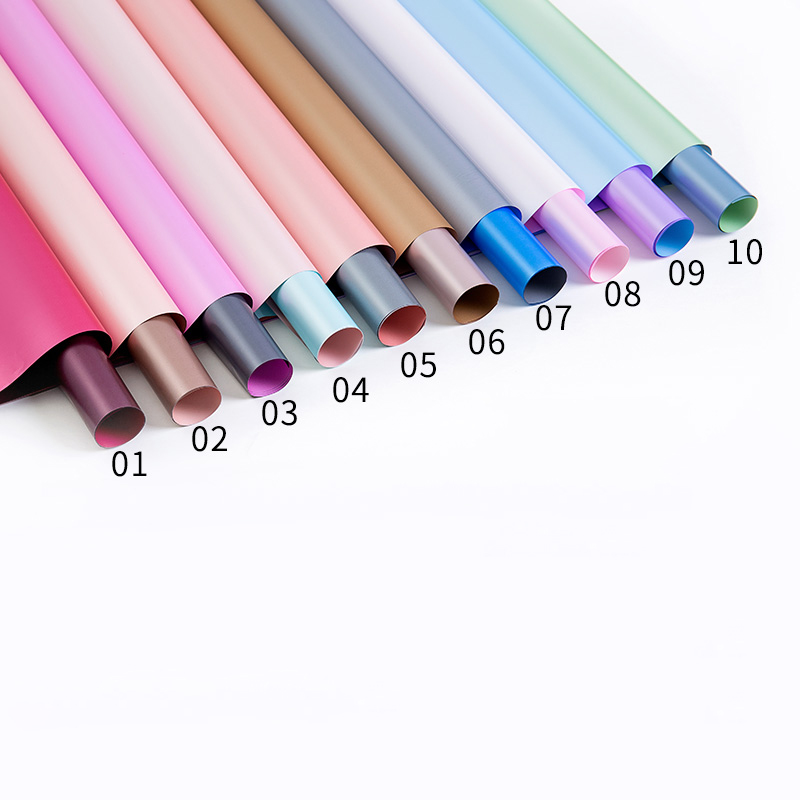 Double-Sided Two-Color Pearl Waterproof Flower Wrapping FilmA waterproof pearlescent BOPP film with a two-sided two-color finish, useful for hand-tied bouquets needing a finished look on both sides.View Product →
Color, Lighting, and Photography
Pearl finishes shift color under different light sources. A warm shop LED may make a champagne pearl look golden, while daylight may reveal a cooler silver undertone. Pale pink, white, and peach flowers are the most sensitive to this shift. Before committing to a large order, test the paper under the lighting used at the counter, in the delivery vehicle, and in a phone camera view. If the pearl surface creates a bright hotspot in photos, angle the bouquet slightly or use a softer pearl rather than moving to a completely matte wrap.
Good wrapping technique also controls reflection. Sharp, flat folds create hard highlights; softly crushed or layered folds break up the pearl sheen and look more natural. A clean three-fold wrap with a defined edge is easier to repeat across staff than a loose, heavily gathered style, and it makes the pearl surface look intentional rather than noisy. For teams training new staff, a professional bouquet wrapping technique is worth standardizing before the paper is reordered.
Quality Checks Before Reordering
Pearlescent paper should be checked as a working material, not just as a color sample. The most common complaints in florist supply are batch color shift, edge cracking, coating scuffs, roll curl, and print misregistration. A supplier may send a perfect sample and a slightly different production lot later, so keep a signed master sample from an approved batch. Compare new deliveries under the same light and on the same flower type. If the difference is visible across a bouquet, the batch is not suitable for repeat retail work.
- Crease a sheet along the intended fold lines and inspect the pearl coating for whitening or flaking.
- Cut across the sheet with normal shop scissors and check whether the edge cracks or delaminates.
- Rub the surface with a dry tissue and a slightly damp tissue to check scuffing and color transfer.
- Measure a sample of sheets for size consistency; small variations affect cutting waste and wrap balance.
- Store the paper flat or in a vertical rack that does not compress the roll, because curl memory can make flat sheets harder to fold.
- Test a finished bouquet in the cooler and in a delivery bag before approving the lot for customer orders.
Set internal tolerances that match the work. A florist who cuts every sheet by hand may accept a small size variation, while a studio producing identical event bouquets may need tighter consistency. The key is to define the tolerance before the order, not after a customer notices a difference between two bouquets from the same collection.
Sourcing and Supplier Questions
For B2B buyers, the useful supplier conversation is about repeatability: can the same pearl tone, base film, sheet size, and edge treatment be supplied across multiple orders? Ask for current production samples rather than archive photos, and request mixed-carton options if the shop sells several color stories. Confirm minimum order quantities, lead time, packaging protection, and the process for damaged sheets. A pearl surface that arrives with pressure marks or roll curl creates waste before it reaches the customer.
The product range shown on lixuanflowerwraps.com includes pearlescent films alongside solid color, waterproof, matte, kraft, cotton, transparent, and plastic wrapping options, plus ribbon, mesh, bags, and floral foam. That breadth is useful when a florist wants one visual system across a bouquet: pearl outer wrap, matte inner layer, and a ribbon that matches the edge tone. It is also a reminder to buy the wrap as part of a finished bouquet plan rather than as a standalone color swatch.
Bottom Line
Pearlescent flower wrapping paper earns its place when it improves the bouquet's perceived finish without hiding the flowers. Choose the base film for the delivery conditions, choose the pearl level for the lighting, and choose the edge or print for the sales occasion. Keep a master sample, test folds and moisture, and reorder only after the paper has passed a real bouquet test. Treated that way, pearl paper becomes a reliable sales tool rather than a risky decorative upgrade.
 +86-18270363850

