 English
 русский
 عربى



add: North of Gaoxin North Road, east of Jinyun Road, Wannian High-tech Zone, Shangrao City, Jiangxi Province
Matte flower wrapping paper is not one material. A matte coated paper and a matte BOPP film can look almost identical on a sample card, yet one may tear at the stem wrap while the other scuffs in a cooler. The practical answer is to choose the substrate and thickness before the color. For most retail bouquets, 4.5 mil matte BOPP film is the everyday default; move to 7.5 mil for structured gift wraps, and use 80–120 gsm matte paper when a natural, dry-handle look matters more than water resistance.
This guide is written for buyers who order by the roll or carton, not for one-off craft projects. The focus is on decisions that change reorder rates: fold memory, print behavior, condensation, width tolerance, and cost per finished bouquet. The full matte flower wrapping paper film range shows how many variables sit behind a single finish name, but the selection logic below applies whether you buy from that range or compare samples from several suppliers.
Why Matte Finish Changes the Buying Decision
Matte finish is a lighting decision as much as a style decision. It reduces specular glare, so a bouquet photographs with softer shadows and fewer hot spots under shop spotlights. That is why matte wraps often suit premium hand-tied bouquets, wedding work, and social-media images. The trade-off is that matte surfaces show finger marks, abrasion, and crease lines more readily than gloss film. A roll that looks clean in the sample book can look tired after ten bouquets on a busy Saturday.
The first conclusion for buyers is simple: do not approve a matte wrap from a 10 cm swatch. Ask for an A4 or 30 cm sample, fold it around a stem bundle, and view it under the same color temperature as your shop or studio. Check the surface after handling it with dry and slightly damp hands. If the finish marks easily, either reserve it for low-touch gift wrapping or specify a scuff-resistant coating. This matters more than a small difference in paper shade because a marked bouquet cannot be sold at full price.
Match the Substrate to the Bouquet’s Journey
Choose the substrate by where the bouquet goes after wrapping, not by the name on the sample card. A dry retail bouquet that leaves the shop within an hour has different needs from a wedding installation that sits in a van, or a wholesale bunch that spends a day in a cooler. Matte paper gives a warm, natural handle and takes ink richly; matte BOPP film gives better water resistance and cleaner folds for volume work. Neither is universally better.
| Decision point | Matte coated paper | Matte BOPP film |
|---|---|---|
| Typical buying spec | 80–120 gsm, coated or uncoated | 4.5–7.5 mil |
| Water behavior | Low unless specifically coated | Good, but cut edges can wick |
| Fold memory | Soft, rounded creases | Crisp creases that can hold shape |
| Print appearance | Rich, absorbent, slightly muted | Sharp, consistent, needs suitable ink adhesion |
| Best use | Rustic, natural, dry retail wraps | Cooler display, transport, structured wraps |
| Main risk | Tearing at tight folds | Scuffing and surface marks |
For premium gift work, a gold-edged matte film can add structure without the glare of metallized gloss. That is the logic behind products such as the
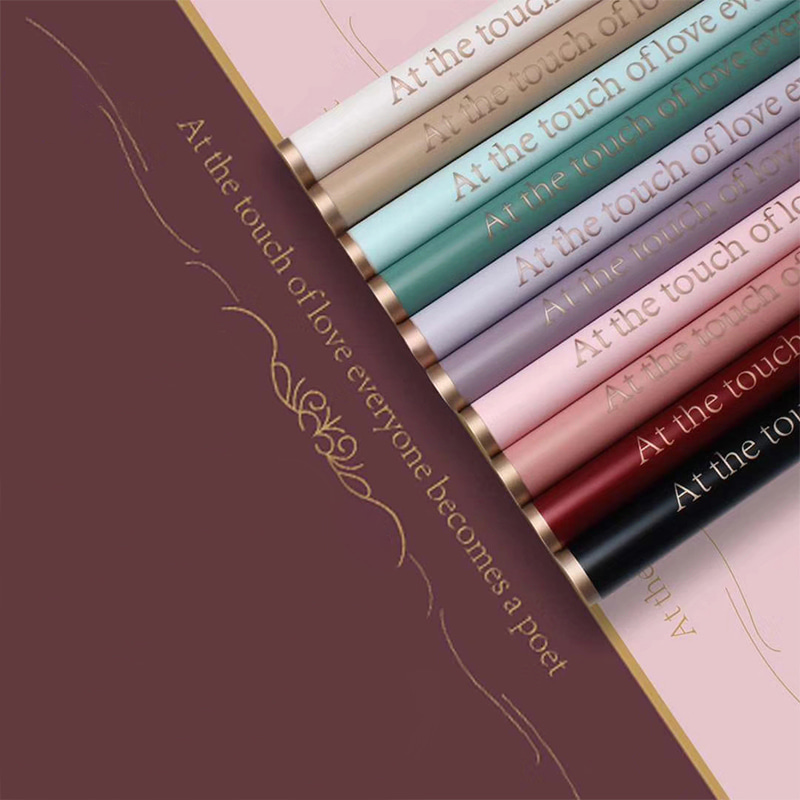 Gold-Edged Matte Flower Wrapping Paper in Nine ColorsA nine-color matte floral wrap with gold edging, suited to premium gift bouquets where edge detail adds structure without metallic glare.View Product →
option, where the edge detail does the decorative work and the matte body keeps the bouquet from looking overly shiny. Test the edge adhesion after folding, because a lifted edge is a visible defect even when the main film performs well.
Thickness, Fold Memory, and Stem-Wrap Pressure
Thickness should be chosen by fold count and stem pressure. A bouquet wrap is rarely one flat sheet; it is folded at the collar, gathered at the stem, and sometimes layered with tissue or mesh. A 4.5 mil matte film is usually sufficient for a three-fold retail wrap, while 7.5 mil gives more body for wide fan shapes and heavy stems. If the film is too thin, the collar collapses; if it is too stiff, the wrap springs open and tape or ribbon has to work harder.
Run a simple fold test before a bulk order. Cut a 57×57 cm sheet, fold it into a three-point collar, and hold it closed for 30 seconds. Release it and measure how far the fold opens. For a controlled retail look, the wrap should stay within roughly 10–15 degrees of the closed position; a large spring-back means the film is too stiff for that fold pattern. Also wrap five stems with a damp stem end and check for crease whitening after 20 minutes. Matte film can show stress marks at sharp folds, especially in dark colors.
For paper-based matte wraps, 80–90 gsm is a good starting point for single bouquets, while 100–120 gsm suits layered wraps and printed designs. Ask for the sheet size in millimeters, not only in inches, and confirm whether the listed size is cut size or roll width. A 57×57 cm sheet is not the same as a 57 cm roll with a 2 cm edge allowance, and that difference affects how many wraps you get per carton.
Print and Texture: Where Matte Helps and Where It Fails
Matte surfaces help print look integrated rather than sitting on top of the film. Fine lines, botanical drawings, and low-contrast patterns read more calmly on matte than on gloss, which is useful for florists who want the flowers to remain the focal point. The risk is that matte print can look dusty if ink coverage is too heavy, and pale colors can shift under warm shop lighting. Approve print under neutral daylight and under your actual display lights, not only on a monitor.
A butterfly or botanical motif works well when the pattern scale matches the bouquet size. Small repeats disappear in a large fan wrap, while oversized motifs can overwhelm a compact hand-tied bunch. A product such as the
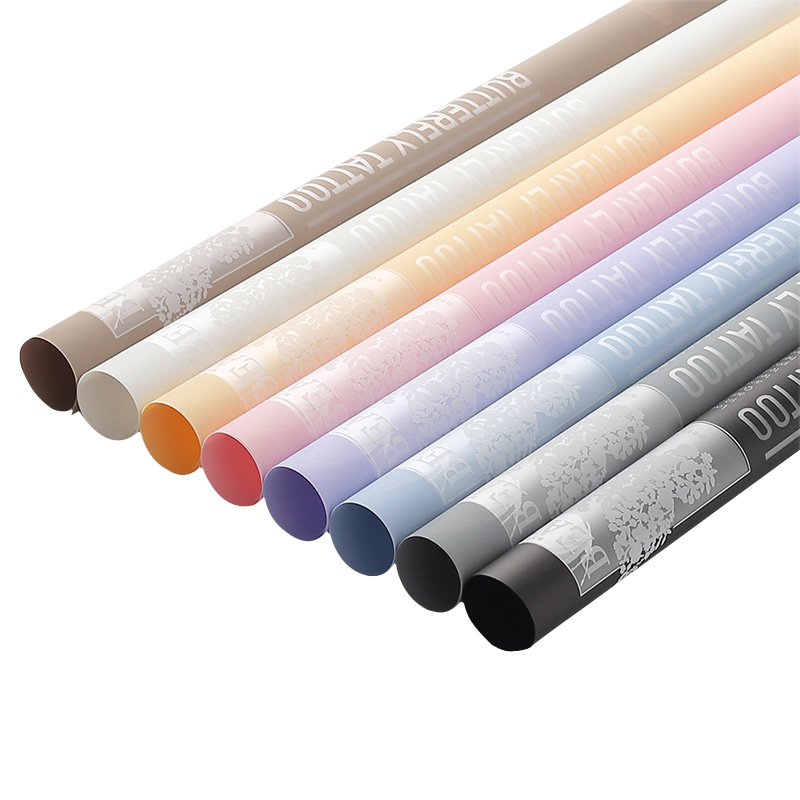 MYHC-14 Butterfly Pattern Opaque Matte Flower Wrapping PaperAn opaque matte BOPP wrap with a butterfly pattern, useful for checking motif scale and repeat placement before wrapping bouquets.View Product →
style is best tested in the final fold, because the visible area after wrapping is much smaller than the flat sheet. Ask for a print repeat measurement and check that the motif does not fall exactly at the collar fold, where it can crack or look cut off.
Texture has a similar practical role. Embossed or lace-effect matte wraps add perceived value, but deep texture can trap dust and make folding less predictable. Lace patterns also create many small edges that can catch on ribbon or mesh. The
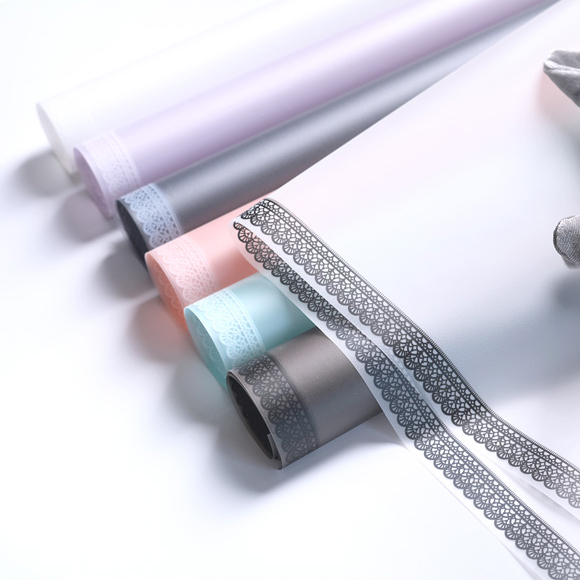 Lace Matte Flower Wrapping Paper for Floral PackagingA lace-effect matte floral wrap for display bouquets and gift work, better suited as a premium accent than a high-volume default.View Product →
option suits display bouquets and gift work where the wrap is handled once or twice, but it is less forgiving in high-volume assembly. If your team folds more than 50 bouquets a day, keep textured matte as a premium accent rather than the default wrap.
Water, Cold Chain, and Condensation
Water resistance is the specification most likely to be overstated in a matte wrap sample. Matte BOPP film can resist surface water, but cut edges, taped seams, and folds can still wick moisture. Matte paper without a coating will spot quickly when stems are wet. For cooler display, the bigger issue is condensation: a cold bouquet moved into warm shop air can form fine droplets on the wrap, and those droplets show more on matte than on gloss.
If bouquets spend time in a refrigerated case, ask for anti-fog performance and test it. Place a wrapped bouquet in a cooler at 4–8°C for 30 minutes, then move it to a 22–24°C room and observe for 10 minutes. A suitable matte film should clear within a few minutes without large droplets running down the surface. Also check the wrap where it touches wet floral foam or a damp stem wrap; a waterproof coating on the face does not guarantee protection at the cut edge. For transport, use an inner tissue or absorbent layer rather than relying on the matte outer wrap alone.
Order Specs and Quality Checks
Write the purchase order around measurable attributes, not color names. “Matte black” can vary from charcoal to blue-black between lots, and a reorder that looks different from the first carton creates visual inconsistency across a shop’s display. The following checks catch most problems before the roll reaches the wrapping table:
- Confirm width and length tolerance; for cut sheets, ±3–5 mm is a practical target, and for rolls, ±2% length is reasonable.
- Ask for the core diameter, usually 2.5–3 inches for dispenser use, and check that the roll fits your existing holder.
- Compare shade across three cartons under the same light; a visible side-by-side difference is a reorder risk even if each carton passes alone.
- Check edge quality; ragged edges slow down folding and create loose fibers or film slivers.
- Test tape adhesion and ribbon grip on the matte face; some low-glare surfaces release tape too easily.
- Confirm whether the matte finish is one-sided or two-sided, especially for wraps that are folded back at the collar.
For paper wraps, ask for moisture content and pH if the supplier can provide it; for film wraps, ask for thickness in mil and a statement on surface treatment. Keep a retained sample from each lot. When a florist complains that the new carton “feels different,” the retained sample turns a subjective argument into a measurable comparison.
Cost, MOQ, and Supply Reliability
Cost per sheet is not cost per bouquet. A cheaper matte wrap that tears at the collar or marks after handling can cost more in remakes than a slightly higher-priced roll that folds cleanly. Calculate cost per finished bouquet using actual usage: if a bouquet uses two sheets, and one sheet costs $0.08, the wrap cost is $0.16. A 10% waste rate adds about $0.016, while a 20% waste rate adds $0.032. That difference is small on one bouquet but significant across 100 bouquets a day.
MOQ should be set against reorder frequency and storage space, not only unit price. Matte film is bulky; 20 rolls can consume more shelf space than a shop expects. Ask for mixed-color cartons if the supplier allows them, but confirm that mixed cartons do not create shade variation within a single color. For seasonal work, place the main order early enough to run a fold-and-cooler test before the busy period. A second container is expensive; a second sample run is not.
Supply reliability also depends on whether the supplier can repeat the same matte surface from lot to lot. If you are comparing occasion-specific styles, the guide to choosing the right wrap for different occasions is useful for range planning, but the commercial decision still rests on repeatability. Ask for the last three production dates for the same SKU and request samples from each batch. Consistent matte gloss level, thickness, and shade matter more than a one-off perfect sample.
A Practical Selection Framework
The shortest path to a reliable matte wrap is to rank the bouquet’s risks before ranking its colors. Use this sequence for a new supplier or a new season:
- Define the bouquet’s journey: dry retail, cooler display, delivery, or event installation.
- Choose paper or film based on water exposure and fold count, then set a thickness range.
- Approve the matte surface with a hand-mark and scuff test, not only a visual check.
- Test print scale and texture in the final folded collar, not on a flat A4 sheet.
- Confirm width, core, shade tolerance, and tape grip in writing before the bulk order.
- Run a small production trial and calculate cost per finished bouquet, including waste.
Matte flower wrapping paper works best when the finish supports the flowers rather than competing with them. A soft, low-glare wrap can make a $12 bunch look considered and a $60 gift bouquet look premium, but only if the substrate survives the fold, the cooler, and the customer’s hands. Start with the handling test, then choose the color. That order keeps reorders predictable and keeps the matte finish from becoming a maintenance problem.
 +86-18270363850

