 English
 русский
 عربى



add: North of Gaoxin North Road, east of Jinyun Road, Wannian High-tech Zone, Shangrao City, Jiangxi Province
A florist orders cherry blossom wrapping paper for a spring wedding sample and receives a roll of fist-sized magenta blooms on glossy film. Folded around white tulips, the pattern overwhelms the flowers. On a natural kraft base, the same pink might have read softer. The paper did not fail because cherry blossom is a weak motif; it failed because print scale, substrate and finish were never matched to the bouquet.
The practical conclusion is simple: buy cherry blossom wrapping paper by matching four things at once — bloom scale, base material, surface finish and moisture exposure. A sakura print that looks delicate on screen can turn heavy in the hand, and a paper that photographs well can crease badly at the fold. For floral work, the paper has to survive taping, folding, stem moisture and a customer’s car boot before it reaches the table.
What Cherry Blossom Wrapping Paper Must Do in a Floral Workflow
Cherry blossom wrapping paper has two jobs. Visually, it should suggest spring, softness and a Japanese garden without competing with the flowers. Physically, it must behave like floral packaging: fold cleanly, hold a shape, resist finger marks and tolerate the damp stems that sit inside a bouquet. Gift wrap is often judged on appearance alone; flower wrap is judged after a two-hour delivery run.
The best results usually come from restraint. A pale pink five-petal print on off-white cotton paper, a fine white blossom line on transparent film, or a muted blossom repeat on kraft will support ranunculus, tulips, lisianthus and white roses. A dense, saturated blossom print on a high-gloss sheet tends to pull attention away from the flowers and can make the bouquet look cheaper than it is.
Where the design usually goes wrong
- Oversized blooms: a large cherry blossom motif on a 57 × 57 cm sheet can look bold when flat but clumsy once folded into a bouquet collar.
- Wrong pink for the base: the same sakura pink reads warm on kraft, cool on white and muddy on a grey or pearlescent film.
- Too much shine: gloss film can photograph with hotspots under shop lighting; matte or pearl finishes usually photograph more softly.
- Weak crease behavior: a paper that cracks along the fold will show white lines across the blossom print.
- No reverse-side plan: florists fold paper back at the collar, so the unprinted side becomes part of the design.
Print Details That Separate a Good Sakura Wrap From a Weak One
Start with scale. A cherry blossom print should be tested at the size it will be seen on a finished bouquet, not as a flat sheet on a desk. A 2 cm bloom may look tiny in a digital repeat but elegant when three sheets are layered around a hand-tied bunch. A 6 cm bloom may look cheerful in a sample book but overpower a 30 cm bouquet. Ask for a printed proof folded around a dummy bouquet, or at least a photo of the paper wrapped around stems at the intended height.
Next, check the repeat. A simple toss pattern hides cutting waste; a directional or half-drop repeat uses more paper and needs cleaner cutting. For cherry blossom designs, the repeat should not create accidental flower clusters at the fold line or a heavy band of pink where the sheet is gathered. If the design includes branches, confirm that the branch direction works when the paper is turned upside down, because florists often rotate sheets to fit the bouquet.
Color is the third filter. Sakura pinks are vulnerable to metamerism: a paper that matches a Pantone chip under office light can shift under warm shop lighting or daylight. Ask for a physical strike-off on the actual substrate, not a CMYK screen proof. On kraft or recycled stock, pale pink needs an opaque white underbase or it will sink into the brown. On pearlescent film, the metallic base can make pink look dusty; a small trial run is cheaper than a seasonal stock mistake.
Finally, confirm print registration and ink adhesion. Fine petal outlines, gold edges and white linework are the details most likely to drift. A registration check should include the folded edge, the cut edge and the reverse side. If the paper is intended for wrapping with tape, test tape adhesion and removal; some films release ink or leave a mark when the tape is lifted.
Choosing the Substrate for Cherry Blossom Wrapping Paper
Cotton paper is often the most natural home for a cherry blossom print. It folds softly, takes matte inks well and gives the bouquet a quiet, handmade feel. The cotton flower wrapping paper range from Lixuan includes lightweight sheets and film-backed options, which is useful when one design needs to sit in both a retail bouquet and a wedding sample. For a petal-like silhouette that supports a sakura theme without literal blossom shapes, the monochrome petal-shaped cotton paper is a practical base to test.
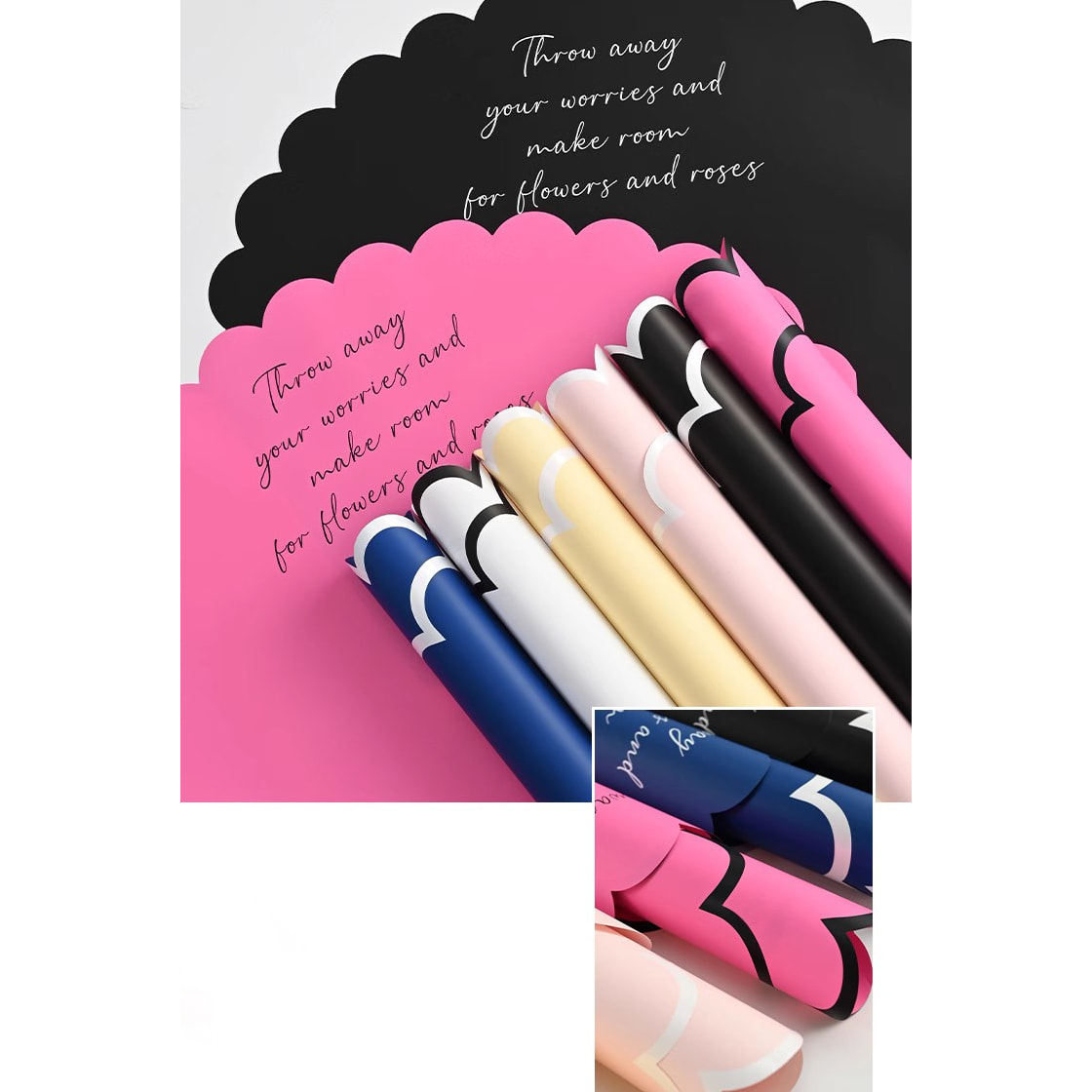 Monochrome Petal-Shaped Cotton Flower Wrapping PaperA 57 x 57 cm monochrome petal-shaped floral wrap in pearlescent film, useful for testing a subtle sakura theme on retail and wedding bouquets.View Product →
Kraft and natural papers
Kraft is a strong choice for rustic, market-style bouquets and for florists who want cherry blossom wrapping paper to feel less sweet. The risk is color control: brown bases shift pink toward salmon or beige, and fine pale petals can disappear. Ask for a proof on the exact kraft stock, not a white-paper proof. Kraft also has a different fold memory; it can hold a crisp angle but may crack on repeated creasing, so sample sheets should be folded and unfolded several times.
Matte and pearlescent films
Matte film gives a modern, low-glare finish and is useful for shops with strong lighting. Pearlescent film adds a soft sheen that suits premium spring bouquets, but it can reduce contrast in pale cherry blossom designs. A gold-edged floral film can be appropriate for gift bouquets and wedding work when the blossom motif is kept small. The vintage camellia pattern shown here is not a cherry blossom print, but it illustrates the same buying principle: a floral motif on a pearlescent base needs a physical proof before it is used across a seasonal range.
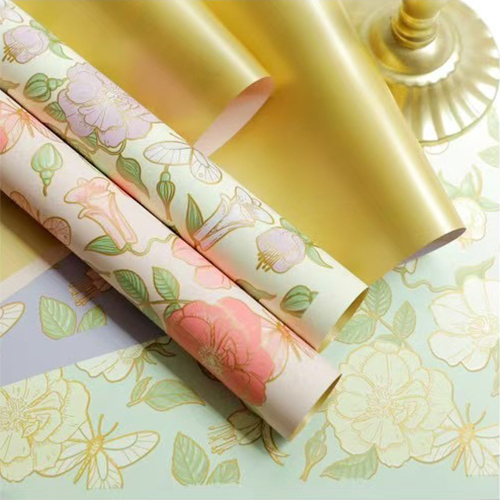 Gold-Edged Vintage Camellia Pearlescent Flower Wrapping PaperA 57 x 57 cm pearlescent film wrap with a gold-edged vintage camellia motif, suited to gift bouquets and wedding work pending a physical proof.View Product →
Transparent and waterproof films
Transparent film is often used as an overlay rather than the main wrap. A fine white sakura print on clear OPP or jelly film can add a seasonal note while letting the flower color show through. The technical check is condensation: in a cooler or delivery van, moisture can cloud the film and flatten the print. Anti-fog treatments and waterproof coatings help, but they should be tested with real stems, not a dry sample. For a lightweight transparent layer, a jelly-film OPP sheet is a useful starting point when the design needs to stay subtle.
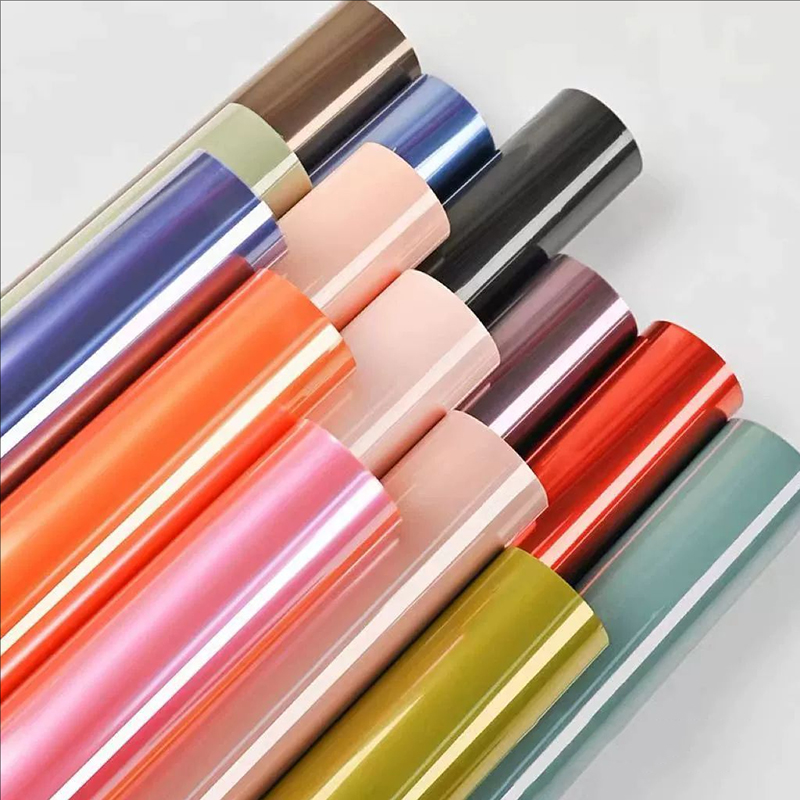 Jelly Film OPP Silk Transparent Flower Wrapping PaperA 57 x 57 cm transparent OPP 4.7 Silk sheet for subtle bouquet overlays, letting flower color show through; moisture testing with real stems recommended.View Product →
Moisture, Structure and the Folding Test
A cherry blossom wrapping paper that is sold for floral use should be tested wet and dry. Dry testing shows print quality; wet testing shows whether the paper will hold up when stems are wrapped in damp paper or the bouquet sits in a cool display. Waterproof films and coated papers reduce bleed-through, but they can also trap condensation. The practical answer is usually a layered build: an absorbent inner wrap near the stems, a structural outer sheet for shape, and a transparent or printed overlay for the cherry blossom theme.
Thickness matters less than hand-feel and fold memory. Plastic films are often specified in mils; 4.5 mil and 7.5 mil appear in common floral ranges, with the heavier film giving more structure and the lighter film giving more drape. Paper buyers should ask for caliper, tear resistance and a fold test rather than relying on a single “thick” claim. A paper that is too stiff will spring open at the collar; one that is too soft will collapse around the stems.
- Fold a full sheet around a bunch of stems and secure it with tape.
- Hold the bouquet upright for ten minutes and check whether the collar sags.
- Mist the stems lightly and leave the wrap in a cool place for an hour.
- Check for ink transfer, soft edges, condensation and crease whitening.
- Repeat the fold in the same place to see whether the print cracks.
A Practical Comparison for Buyers
The table below is a starting point for matching a cherry blossom design to the right substrate. It is not a substitute for a physical sample, because print color and fold behavior change with the actual stock, ink and coating.
| Substrate | Best for | Print behavior | Procurement check |
|---|---|---|---|
| Cotton paper | Soft retail bouquets, wedding work, natural cherry blossom prints | Matte inks sit cleanly; pale pink needs a controlled white base | Fold test, reverse-side color, sheet-to-sheet shade consistency |
| Kraft paper | Rustic bouquets, market-style wrapping, muted sakura designs | Brown base warms pink and can dull fine petal lines | Proof on the exact kraft stock; check crease cracking |
| Matte film | Shop display, modern bouquets, low-glare photography | Crisp print, but dark inks can look flat without texture | Ink adhesion, tape release, scuff resistance |
| Pearlescent film | Premium gift bouquets, spring campaigns, gold-edge finishes | Shimmer adds depth but can mute pale cherry blossom pinks | Physical strike-off, edge wear, batch-to-batch shimmer |
| Transparent or waterproof film | Overlays, delivery bouquets, cool-chain display | White ink reads clearly; fine print can disappear against busy flowers | Anti-fog test, condensation test, print opacity |
Seasonal Buying and Range Planning
Cherry blossom wrapping paper is a seasonal motif, but seasonal does not mean single-use. A sensible range usually has three layers: a core off-white or kraft sakura print for everyday bouquets, a pale pink or pearl version for spring promotions, and a transparent overlay for gift upgrades. That structure gives florists a way to change the look without changing the wrapping method. It also reduces the risk of over-ordering a strong pink that only suits one week of the year.
Buyers should confirm repeat size, sheet size, pack quantity and minimum order before committing to a seasonal program. Common floral sheet sizes such as 57 × 57 cm and 58 × 58 cm behave differently when folded, so a design approved on one size should not be assumed to work on another. If the paper is sold in rolls, check core diameter, roll length and whether the print direction allows efficient cutting. If it is sold in packs, check that the pack is flat enough for shop storage and that the sheets are not creased in transit.
It also helps to compare the design against the occasions the shop actually sells. A cherry blossom wrap that suits Mother’s Day may be too delicate for a bold birthday bouquet; a kraft sakura print may suit sympathy work better than a pearl film. This internal guide to matching flower wrapping paper to occasions is useful when building a small but coherent range.
Supplier Checks for Cherry Blossom Wrapping Paper
Jiangxi Lixuan New Material Technology Co., Ltd. is a B2B flower packaging supplier based in Shangrao, Jiangxi, with a product catalog that covers cotton, kraft, matte, pearlescent, waterproof and transparent flower wrapping films, plus ribbon, mesh, bags and floral foam. Its About page states that production lines are automated to improve consistency and reduce human error, and that products are designed with national environmental standards and recyclability in mind. Those are supplier statements; buyers should still request the specific test reports and material declarations needed for their market.
The catalog’s MYHC numbering is useful for buyers because it shows a continuous product development sequence rather than a loose collection of one-off prints. For a cherry blossom program, the relevant question is not only whether a sakura print exists, but whether the supplier can hold the same pink, repeat and fold behavior across repeat orders. Ask for the following before placing a seasonal order:
- A physical sample from the current production lot, not a generic color card.
- A folded bouquet sample showing the print at finished scale.
- Sheet size, pack quantity, carton dimensions and pallet configuration.
- Ink adhesion, moisture resistance and fold test results.
- Reverse-side appearance and edge finish for gold-edge or white-edge designs.
- Lead time for repeat orders and the minimum order for custom cherry blossom artwork.
For custom work, send a clear brief: the bouquet size, the flower colors, the desired sakura scale, the base material, the finish and the storage conditions. A supplier who asks for those details is easier to work with than one who only sends a flat print proof. Cherry blossom wrapping paper is a visual product, but the buying decision is still a packaging decision. The right sheet protects the flowers, folds without drama and leaves the blossom print where it belongs — in support of the bouquet.
The strongest cherry blossom wrapping paper rarely shouts. It gives the flowers a seasonal frame, keeps its color at the fold and survives the trip from bench to customer. Match the print to the bouquet, test the substrate in the hand, and confirm the supplier’s batch consistency before the spring rush begins.
 +86-18270363850

