 English
 русский
 عربى



add: North of Gaoxin North Road, east of Jinyun Road, Wannian High-tech Zone, Shangrao City, Jiangxi Province
A flower shop orders 2,000 sheets of ivory cotton flower wrapping paper in 57 × 57 cm. The first carton behaves exactly as expected: soft in the hand, a clean crease along the fold, a matte surface that photographs well. The second carton tells a different story. The sheets feel thinner, the ivory reads slightly warmer, and the crease along the collar cracks after two folds. By Saturday the bouquets wrapped from that carton look tired before they leave the cooler, and the shop is stuck in a returns conversation it cannot win.
That sequence is the most common failure in this product category, and the pattern printed on the sheet has nothing to do with it. Cotton flower wrapping paper is a folding material before it is a decorative one. Buyers who choose it on colour and price alone usually pay again — in rework, in rejected cartons, or in bouquets that sag in the display.
The short version: specify the base sheet, the laminate, the caliper and the colour tolerance in writing, then judge each delivered batch against a retained sample. Everything else — dots, petals, contrast borders, metallised reverses — is a design decision layered on top of those four. The sections below explain what each specification changes at the wrapping table, how sheet size drives cost per bouquet, where moisture problems appear, and which checks are worth building into an incoming inspection routine.
What the Term "Cotton Flower Wrapping Paper" Actually Covers
The phrase describes a family of products, not a single item. Two suppliers can both quote "cotton paper" and deliver materials that behave nothing alike. Four variables separate them.
The base sheet. In floral grades, the base is usually a lightweight tissue or paper made from wood pulp; better grades include cotton linter fibre, which gives a softer hand and a more forgiving crease. Some of what is sold as cotton paper contains no cotton fibre at all and is simply a fine, matte tissue named for its feel. There is nothing wrong with that, provided the buyer knows which one is arriving on the pallet.
The laminate. Unsupported tissue is breathable, absorbent and fragile. Most bouquet-grade cotton paper is bonded to a thin BOPP or OPP film on one face, which turns a delicate sheet into something that holds a fold, resists stem moisture and survives a delivery van. The film side is usually the matte exterior; the paper side often faces the flowers. Check which face carries the print.
Weight and caliper. These are not the same number and they do not move together. Base weights for unsupported floral tissue commonly sit in the 17–25 gsm range, while laminated versions are quoted either as a base weight plus film or as a combined weight in the 40–60 gsm region. Caliper, measured in microns, is the better predictor of fold behaviour: a denser sheet at the same nominal weight creases more cleanly and springs back less.
Format. Sheets dominate retail floristry because they suit hand folding; rolls dominate higher-volume workshops that cut to length on a bench dispenser. A roll reduces trim waste but demands a straight cut and a storage rack, so it rarely suits a shop with limited floor space.
Three questions to a prospective supplier will separate most offers quickly. Is the sheet unsupported tissue or film-laminated, and on which face? What is the base weight and what is the combined weight? Is the print single-sided or double-sided, and what colour is the reverse? If those answers arrive vaguely, the batch consistency is likely to be vague too.
Four Jobs Cotton Paper Does in a Finished Bouquet
Cotton paper earns its place in the workroom for reasons that have little to do with how it looks flat on a shelf. Understanding the four jobs makes specification much easier.
Light control
A matte cotton surface scatters light instead of reflecting it. Under the 3000K spotlights most shops run, a glossy film produces a hard highlight that pulls the eye away from the flowers and turns harsh in phone photographs. Cotton paper produces a soft gradient, which is why it dominates in social-first retail. The effect is strongest in pale neutrals — ivory, bone, warm grey — where there is no strong colour to compete with the blooms.
Dry touch and moisture buffering
Unsupported cotton paper absorbs. That is an advantage when a stem end weeps onto the liner: the sheet takes up the moisture and the outer wrap stays visually clean. It becomes a liability when the sheet sits against wet floral foam for hours, because absorbed water raises tide marks that read as dirt. The practical rule is to keep a barrier — a small piece of film or a waterproof inner sheet — between wet mechanics and any uncoated cotton layer.
Fold memory
This is the property buyers notice first and specify last. A good cotton sheet takes a crease under a thumb and holds the angle long enough to be secured with ribbon or tape, then relaxes just enough to give a soft, airy volume. A sheet that is too light collapses into the flowers within an hour; one that is too stiff creases into hard geometric lines that look mechanical rather than hand-finished. Caliper and fibre length determine which of the three you get.
Colour neutrality
Cotton paper functions as a colour reference for the whole arrangement. A warm ivory flatters reds, peaches and garden roses; a cool white sharpens blues, purples and greens but can make cream flowers look yellow. Shops that keep three or four neutral bases in stock gain far more styling flexibility than shops that keep fifteen novelty patterns and no reliable neutral.
Comparing Cotton Paper with the Alternatives on the Same Bench
Most sourcing decisions are comparative. The table below sets out how the main wrapping materials behave at the wrapping table rather than in a catalogue photograph.
| Material | Feel and fold behaviour | Moisture behaviour | Typical best use | Main risk |
|---|---|---|---|---|
| Unsupported cotton tissue | Soft and breathable; takes a crease but softens within hours | Absorbs readily; can show tide marks | Everyday retail, airy and rustic styles | Tearing at the stem tie; water staining |
| Film-laminated cotton paper | Crisp, holds a puff, sharp permanent creases | Resists water; can trap condensation | Gift bouquets, delivery, cooler display | Edge delamination; creases cannot be pressed out |
| Kraft paper | Stiff and dry; strong but unforgiving on tight folds | Poor without a coating | Rustic, market and sympathy work | Cracking along folds; narrow colour range |
| Matte BOPP film | Springy with strong memory; does not crease flat | Fully waterproof | Volume work and transport | Reflects under flash; no absorbency |
| Pearlescent film | Smooth with a sheen and medium body | Waterproof | Premium, festive and wedding work | Fingerprints and surface scratches |
| Transparent OPP or cellophane | Stiff, transparent, very sharp folds | Waterproof | Showing the flowers themselves | Scuffing and visible condensation |
Read the table as a starting point for sampling, not as a verdict. A heavier laminated cotton sheet can do most of what a matte film does while keeping a paper face on the outside, which is why laminated cotton has taken share from both plain tissue and pure plastic film in gift-led retail. The trade-off is recyclability, covered later.
Sheet Size, Trim Waste and Cost per Bouquet
Sheet size is where paper quietly becomes a cost line. The 57 × 57 cm square is close to a de facto standard in hand-tied work because it produces roughly 40–45 cm of visible wrapped height around a medium bouquet with three or four sheets, without requiring a cut on the diagonal. Larger 58 × 58 cm sheets suit generous armfuls and long-stemmed lilies; 45 × 50 cm sheets suit posies, bud vases and small gift arrangements where a full square would need trimming anyway.
The arithmetic is simple and rarely done. Take a shop wrapping 120 bouquets a week at four sheets each: that is 480 sheets a week, roughly 25,000 a year. At a sheet price of 0.12 that is about 3,000 a year in wrapping paper. At 0.09 it is 2,250. The difference looks attractive until the cheaper sheet needs five sheets per bouquet and produces an 8 percent reject rate through tearing and staining: 0.09 × 5 × 1.08 comes to 0.486 per bouquet against 0.48 for the better sheet, and the better sheet also photographs better. Price per sheet is the least useful number on the quotation. Price per finished bouquet, including waste, is the useful one.
Waste usually comes from three places. Diagonal cuts to create a swooping collar throw away a triangle from every sheet. Petal-shaped or die-cut sheets remove that labour but reduce usable area, so a die-cut sheet that looks cheaper per unit can cost more per bouquet. Finally, edge damage in transit turns the outer few centimetres of a carton into scrap; square, well-packed cartons matter more than buyers expect.
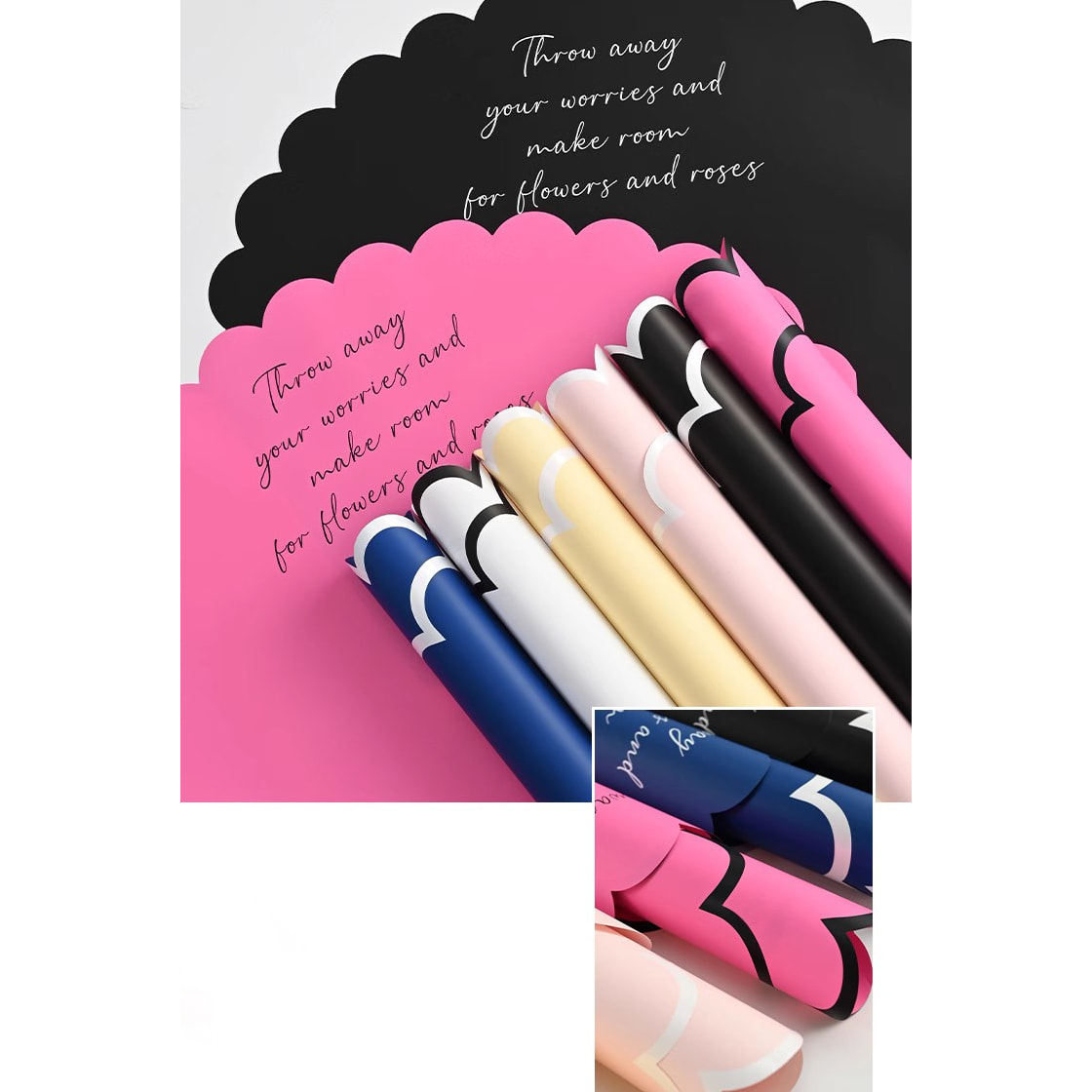 MYHC-71 Monochrome Petal-Shaped Cotton Flower Wrapping PaperPetal-shaped BOPP wrapping paper in 57×57 cm sheets, offered wholesale for florists comparing die-cut formats with cutting waste and per-bouquet cost.View Product →
Where a shop wraps more than roughly 80 bouquets a week, a roll format with a bench cutter usually beats sheets on both waste and speed, provided someone is trained to cut square and the roll is stored upright so the edge does not flatten.
Print, Coating and Edge Finish: What Changes When You Fold
Print decisions made on a flat sheet often look wrong once the paper is wrapped, because folding hides one face and exposes another.
Single-sided print leaves a plain white or kraft reverse. That reverse becomes visible exactly where customers look most closely — the rolled-back collar at the top of the bouquet and the folded lip near the tie. A plain reverse is perfectly acceptable in a rustic or minimal style; it looks unfinished in premium gift work. When ordering single-sided print, confirm whether the reverse is white, off-white or kraft, because "plain" is not a colour.
Double-sided print removes that problem and costs more. Two-colour double-sided constructions, sometimes with a metallised layer on one face, allow the collar to be rolled back deliberately so a contrasting colour shows. They also let a florist reverse the sheet mid-wrap if a print defect appears on one side, which reduces reject rates in a busy workroom.
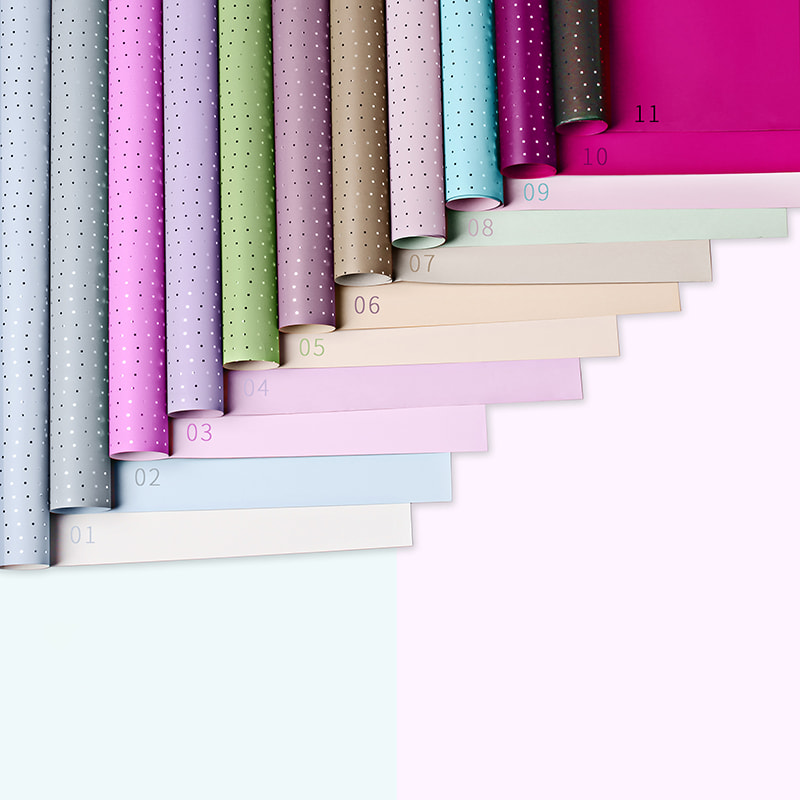 MYHC-34 Double-Sided Aluminized Dot Flower Packaging FilmDouble-sided two-color aluminized BOPP film with dot decoration, sized 57×57 cm for florists seeking reversible, celebratory floral wraps in wholesale packs.View Product →
Metallised and pearlised faces
A thin aluminium-plated layer produces a mirror shimmer that reads as celebratory under shop lighting. Two things follow. First, creases become permanent highlights, so the sheet must be folded decisively rather than adjusted repeatedly. Second, the metallised face shows fingerprints and tap residue, which means the wrapping table needs clean hands and a proper tape rather than a thumb smear.
Edge treatments
Gold or silver edges, contrast borders and printed lace effects all draw the eye to the outline of the wrap, which is exactly the line that gets handled, cut and folded. Edge-printed sheets therefore show handling damage faster than plain-edged ones. If a shop uses them for display bouquets rather than transport, that is a fair trade. If the same sheets go into delivery boxes, expect visible edge wear on arrival.
Whatever the finish, test the laminate bond before committing to volume. A simple tape-peel test on a sample — press tape across the paper face, lift sharply, and look at whether fibre or film comes away — reveals weak adhesion that will delaminate in a humid cooler within weeks.
Pattern Density and the Folding Problem
Pattern scale is judged on a flat sheet and paid for on a finished bouquet. A 2 cm polka dot on a 57 cm square becomes a large motif once the sheet is gathered into a collar roughly a third of its original width, and a dense repeat that looks lively in a sample book can turn muddy when folded three times.
Three pattern behaviours are worth checking on a sample before a bulk order. First, repeat scale after folding: fold the sheet as the shop would, then stand back two metres and ask whether the motif still reads. Second, directionality: stripes, grids and printed text all have an axis, and text in particular is read at an angle once wrapped, so a newspaper-style or lettered print needs to be oriented deliberately rather than dropped on the bench. Third, registration: patterns that cross a fold line split visibly if print registration between passes is loose, which is most obvious on two-colour work and on borders.
Colour is the other half of the decision, and it is where catalogue photography misleads. Evaluate candidate sheets in daylight, then under the shop's actual lighting, then through a phone camera, because those are the three conditions a customer sees. Small dye-lot differences that are invisible in daylight can read as a distinct shade change under warm spotlights, and mixing two lots in one display looks like carelessness even when the specification is identical.
A workable colour strategy for most shops is six to eight core stock-keeping units rather than forty. Two or three neutrals, one deep tone for sympathy and formal work, one metallic or pearl for celebration, and two patterned options for seasonal variety cover the large majority of orders while keeping batch consistency manageable. A small, stable palette also makes it far easier to match paper to a ribbon range and to reorder without colour drift.
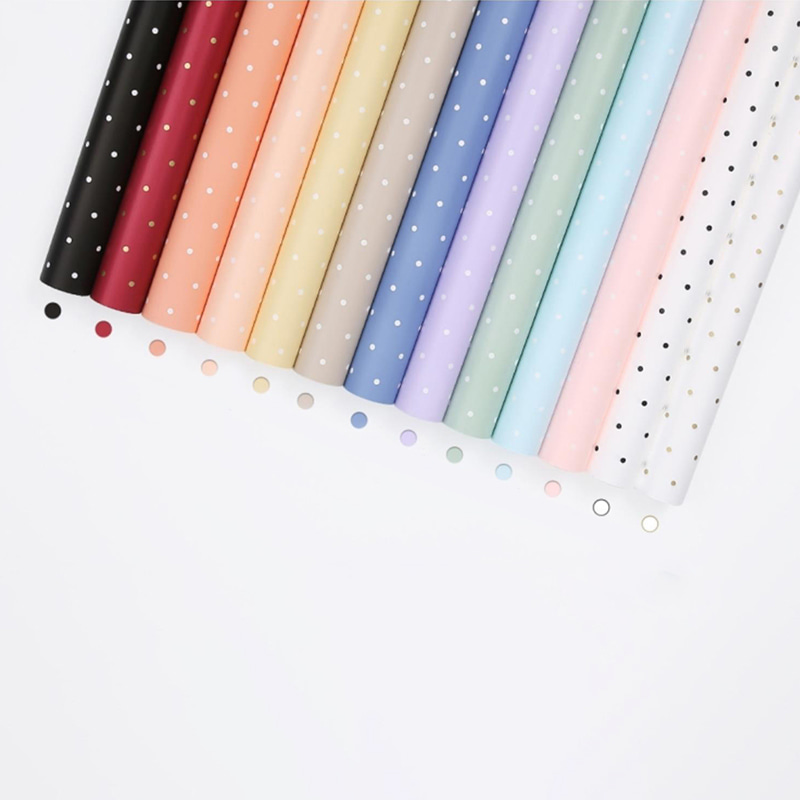 MYHC-37 Monochrome Dot Cotton Flower Wrapping PaperMonochrome dot BOPP wrapping paper in 57×57 cm sheets, a patterned option for florists building a small, consistent core palette for bouquets.View Product →
Where style choices feel difficult, it helps to work from the flowers outward rather than from the paper inward — a principle covered in this short guide to which wrapping paper looks good on flowers, which is useful reading before a seasonal range is locked in.
Moisture, Condensation and the Cold Chain
Water is the most common cause of complaints about cotton flower wrapping paper, and it is almost always a system problem rather than a paper defect.
Uncoated cotton tissue absorbs water from any surface it touches. Stems that have just been cut, floral foam that has been soaked, and sleeves that were misted all release moisture into the wrap. The paper takes it up and, depending on the dye and sizing, shows a darker tide line that customers read as a stain. The fix is mechanical: keep a film barrier between wet media and absorbent paper, and never store finished bouquets with the paper resting directly on soaked foam.
Laminated cotton paper reverses the problem. It keeps water out, but it also keeps water vapour in. In a humid cooler, air trapped between the film and the flowers condenses on the film, and the customer sees droplets on the inside of the wrap. Two remedies work: an anti-fog treated film on the inner face, or a breathable construction that lets vapour escape. Anti-fog performance degrades over time and with surface contamination, so it is worth asking how the treatment is applied and whether the supplier has data on how long it lasts.
Temperature transitions matter as much as humidity. Paper that has spent the night at 4–8 °C in a cooler and is then moved to a 22 °C shop floor will attract condensation on any cool, non-absorbent surface. Letting wrapped bouquets equalise in their delivery box for twenty minutes before display reduces visible fogging considerably.
A quick, cheap test settles most of these questions before a bulk order. Lay a sheet flat, place a freshly cut, wet stem end on it, cover with a second sheet, and leave it for 24 hours in the conditions the bouquet will actually experience. Whatever the sheet does then is what it will do in the cooler, and the test costs one stem and one day.
A Specification You Can Actually Enforce
Most quality disputes trace back to a purchase order that described a product by name and colour only. The table below converts the things that matter into enforceable lines. Tolerances are indicative starting points for negotiation, not universal standards.
| Specification item | How to state it | Indicative tolerance | How to check |
|---|---|---|---|
| Base weight | gsm of the paper layer, stated separately from the film | ±5 percent | Cut a known area and weigh on a bench scale |
| Combined weight | Total gsm including laminate or coating | ±5 percent | Same method, whole sheet |
| Caliper | Microns, measured at three points per sheet | ±10 percent | Micrometer, centre and both edges |
| Sheet size | Width × length in cm, cut square | ±0.5 cm, diagonal difference under 0.5 cm | Tape measure across both diagonals |
| Colour | Reference sample or Pantone number, per dye lot | Visual match under agreed lighting; no mixed lots in one carton | Compare against a retained golden sample |
| Print registration | Maximum offset between colour passes | 2 mm | Inspect a folded sheet, not a flat one |
| Laminate bond | No separation under tape peel | No visible lifting | Tape peel test on three sheets per carton |
| Moisture content | Percentage at packing | Typically 6–8 percent | Supplier certificate or meter reading |
| Packing | Sheets per pack, packs per carton, carton dimensions | Exact count, no mixed patterns | Count two cartons per delivery |
An incoming inspection routine does not need to be elaborate, but it does need to be consistent. A practical sequence:
- Photograph the carton label and record the lot number before opening.
- Pull three sheets from the top, middle and bottom of the carton.
- Compare colour against the retained golden sample in daylight and under shop lighting.
- Fold one sheet as it would be folded on a bouquet and inspect the crease for cracking.
- Run a tape peel test on the laminated face.
- Measure one sheet across both diagonals to catch out-of-square cutting.
- Weigh one sheet if weight drift is a known issue with that supplier.
- Log the result, and quarantine the lot rather than releasing it on trust.
The point of quarantine is not to reject cartons; it is to avoid discovering a drift in week six, when the disputed lot has already been wrapped around four hundred bouquets and the cause can no longer be proven.
Bulk Economics and Choosing a Supplier
Paper is bulky and light, which means freight is often a larger share of landed cost than the unit price suggests. A carton with a higher sheet count per cubic metre can be cheaper to land than a nominally cheaper carton that ships half-empty. Ask for carton dimensions and sheets per carton alongside the price, then compare cost per pallet position rather than cost per sheet.
Minimum order quantities interact badly with pattern variety. A supplier may ask for a few thousand sheets per colour or per pattern, which is comfortable for neutrals and painful for the twelfth novelty print. Two workable approaches exist: concentrate volume in a small core palette and buy patterns in mixed cartons, or accept that niche patterns come at a higher unit cost and price them into the arrangements that use them.
On the supplier side, four questions separate a manufacturer from a trader with a catalogue.
- Is lamination and printing done in-house, and on what equipment?
- What is the standard lead time for a repeat order, and how does it change at peak season?
- Can the same base sheet be supplied across multiple patterns, so that caliper does not change when the pattern changes?
- What documentation is available — weight, composition, coating type, recycled content, test reports?
The third question matters more than it appears. Shops often discover that their ivory and their polka dot come from different base sheets, so one folds beautifully and the other cracks. Locking a single base sheet across the range keeps behaviour consistent and simplifies staff training.
Sample approval deserves its own step. Approve a physical sample, sign and date it, keep one copy at the shop and ask the supplier to retain a matching copy, and write the approval reference onto every subsequent purchase order. When a carton later feels different, the conversation is about a documented reference rather than about memory. Trial orders of two to four cartons across two seasons reveal more about consistency than any single delivery, because seasonal demand changes which production line a supplier runs.
Storage and Handling in the Shop
Cotton paper is hygroscopic. It takes up and releases moisture with the room, and it creases permanently if stored badly. Three habits prevent most storage losses.
Store flat, not upright. Sheets standing on an edge bow under their own weight, and a bowed sheet folds unevenly. If space forces vertical storage, use a rigid sleeve and keep the stack shallow.
Control humidity. A relative humidity somewhere around 45–60 percent keeps the sheet supple without making it damp. Stores that are hot and dry in winter produce brittle sheets that crack on the fold; damp back rooms produce wavy sheets and print offset between layers.
Keep light and dust off open stock. Printed surfaces fade, and metallised or pearlised faces pick up dust that shows as a dull patch. A closed carton with the lid replaced after each pull is unglamorous and effective.
On the workroom side, two small changes reduce waste noticeably. Pre-cut liners in batches so the wrapping table is not doubling as a cutting bench during peak hours. And rotate stock on a first-in-first-out basis, marking the receipt date on each carton, because paper that has sat for eighteen months behaves differently from paper delivered last month — even from the same supplier and the same specification.
Recyclability Claims and What They Actually Mean
Cotton paper is often presented as the environmentally preferable choice, and for unsupported, uncoated sheets that claim usually holds: paper fibre is widely accepted in mixed paper recycling, and an uncoated, unprinted sheet is about as straightforward a material as floristry uses.
Lamination complicates the picture. A paper layer bonded to a plastic film is a composite, and many municipal systems cannot separate the two. Some mills accept it; many do not. The honest position for a shop is to ask the supplier three specific questions rather than accept a general sustainability statement: what is the film made of and how thick is it, is the coated or metallised version accepted by local recycling infrastructure, and are the inks water-based or solvent-based?
Claims about recycled content, fibre sourcing and compostability should be supported by documentation rather than by a logo on a sample card. Where a supplier publishes only a general environmental commitment, treat that as a statement of intent and specify any requirement you actually need — recycled fibre percentage, certification reference, coating type — as a line on the purchase order. Buyers who ask for evidence usually find that suppliers with a genuine position answer quickly, and that the answer is more useful than the marketing page.
There is also a practical waste-reduction lever that has nothing to do with material choice: buying the right sheet size. A shop that trims 8 cm off every sheet is wasting more material each week than any difference between two comparable papers.
Matching the Sheet to the Sale
Different parts of a florist's business put different demands on the same product, and a single paper rarely serves all of them well.
- Everyday retail: unsupported or lightly laminated cotton in two or three neutrals, chosen for a clean fold and low cost per bouquet. Speed of wrapping matters more than surface shimmer.
- Gift and celebration: laminated cotton with a double-sided or metallised finish, where the collar is rolled back to reveal a contrast. Accept the higher unit cost because the perceived value is the product.
- Wedding and event work: consistent colour across large batches matters more than pattern. Order the whole event from one lot and keep a reserve, because a shade difference between two arches of bouquets is far more visible than any single-sheet defect.
- Sympathy and formal work: deep, matte, unpatterned tones with a clean crease. Pattern and shimmer read as inappropriate here, and a soft matt surface photographs respectfully.
- Delivery and wholesale: film-laminated or matte film constructions that survive compression and moisture, with a plain exterior that hides handling marks. Absorbency is a liability in this channel, not a benefit.
The finishing details carry a surprising share of the perceived quality. A sheet that folds well but is tied with a ribbon that slips or a tape that yellows undermines the whole bouquet, which is why it pays to match paper and trims from the same supplier where possible — for example by pairing a cotton wrap with a ribbon from the same floral ribbon range so that widths, sheens and colour temperatures stay in family.
Finally, train the wrapping decision rather than leaving it to habit. A one-page sheet on the workroom wall — which paper for which price tier, which side faces out, how many sheets per bouquet size — removes most of the inconsistency that customers notice as "the last one looked different".
Cotton flower wrapping paper is a small line item that decides how a bouquet is perceived in the two seconds before a customer reacts to the flowers. The material that folds cleanly, holds its shape for a full day on the display, resists the moisture of a working cooler and matches the previous carton is worth more than a cheaper sheet that does three of those four things.
Build the specification first, sample against it, keep a signed reference sheet, and inspect deliveries against that reference rather than against memory. Choose the base sheet for fold behaviour, the laminate for the moisture conditions the bouquet will actually meet, and the pattern last. Shops that work in that order tend to buy less paper, waste less of it, and stop having the conversation about the carton that felt different.
 +86-18270363850

